Executive insigh


blog search

Executive Insights :

1 2 3 4 5

David Fellers

Dave is CEO of Bramasol. After joining the company in 2007 as VP of Professional Services, he became CEO in 2011 and has led the company through record-setting growth and revenues highlighted by a successful re-focusing on serving the Office of the CFO. By building a deep and broad consulting practice that leverages our Comply, Optimize, Transform™ disciplines and a track record of co-innovation with SAP, Dave has positioned Bramasol as the go-to partner for clients that are looking to move into the Digital Solutions Economy and/or to leverage the Digital Transformation of finance using SAP S/4HANA.
Find me on:

Recent Posts

C-Suite Roles are Shifting in Response to Cloud, AI, and Digital Transformation

Wed, Dec 10, 2025 @ 07:34 AM / by David Fellers

The global economy is undergoing a profound transformation. Products are turning into platforms, services are being bundled with data and experiences, and value is shifting from one-time transactions to continuous relationships. This new paradigm, known as the Digital Solutions Economy (DSE), is redefining how companies create, deliver, and monetize value. It’s an economy built on subscriptions, usage-based billing, outcome-driven engagements, and dynamic bundling of products and services.

In parallel, the shift to Cloud ERP is turning core processes into configurable, continuously updated services, with enterprise AI (such as gen-AI, predictive, & agentic) across finance, supply chain, commercial, and service layers, feeding decisions with real-time telemetry and AI analytics. Meanwhile, DSE models (subscriptions, pay-as-you-go, outcome SLAs, bundling of products + services + data) are shifting revenue profiles, cash flow timing, and customer success motions.

At the center of these transformational changes, SAP provides a comprehensive technology platform, based around an end-to-end, cloud-based, intelligent digital core that connects and unifies processes across finance, sales, service, and supply chain. Partnering alongside SAP is Bramasol, a long-time innovation leader helping enterprises turn these technologies into real-world growth, compliance, and performance.

How C-Suite Roles are Changing

CEO: From strategy and oversight to orchestration of an AI-enabled business

The CEO’s role is transforming from managing various operational silos to orchestrating growth across the enterprise and throughout the entire customer lifecycle.

New mandates:

  • Business model agility: Rapidly test/launch hybrid offers (hardware + software + services + data) with dynamic bundling and price experimentation; scale what wins.
  • Operating model convergence: Collapse silos between Sales, Product, Finance, and Service into Revenue Operations (RevOps) and Customer Success spine powered by the ERP + CPQ + billing + RevRec stack.
  • AI ambition with guardrails: Set enterprise AI North Star defining where to differentiate vs. standardize, along with clear risk and ethics boundaries.

Key CEO decisions

  • Approve a portfolio governance cadence with quarterly lifecycle reviews (create → price → sell → bill → renew → expand → retire).
  • Sponsor a connected-data program to unify product, customer, usage, financial and service data as strategic assets (not IT projects).
  • Tie leadership incentives to Lifetime Value (LTV) and Customer Acquisition Cost (CAC), focusing on expansion of Annual Recurring Revenue (ARR), Monthly Recurring Revenue (MRR) net revenue retention (NRR), attach/upsell, and time-to-value.

CFO: From historical reporter to subscription economics architect

For DSE and digital transformation, the CFO becomes the economic architect of the business model. Instead of primarily analyzing and reporting on results, finance now shapes monetization strategy and ensures every revenue stream is compliant, auditable, and predictable.

New mandates:

  • Revenue architecture: Own the compliance-safe bridge from quote → contract → usage → invoice → revenue recognition (ASC 606/IFRS 15), including Standalone Selling Price (SSP) management for bundles and promotions.
  • Predictive finance: Use AI to forecast ARR/MRR, cash collections, churn/expansion, and scenario test pricing/packaging changes before go-live.
  • Monetization governance: Chair a Monetization Council (pricing, offers, incentives, discounting thresholds) with real-time guardrails embedded in CPQ and billing.
  • Close and compliance automation: Drive continuous close, automated reconciliations, anomaly detection, and policy enforcement.

CFO dashboards/KPIs:

  • Topline: ARR/MRR, NRR, Gross Revenue Retention (GRR), bookings mix (new vs. expansion), attach & bundle penetration, usage, bill yield.
  • Profitability: Gross margin by offer, cloud COGS, service utilization, promotional leakage.
  • Cash: Billings, collections velocity, DSO, renewal cash profile.
  • Controls: RevRec exceptions, SSP variance, quote/contract policy breaches, audit-ready traceability.

CIO: From systems owner to platform and data product GM

For CIOs, the DSE era requires a clean-core ERP that can adapt quickly to new offers and partnerships. CIOs design and implement composable architectures using SAP S/4HANA Cloud and the SAP Business Technology Platform (BTP)—keeping the ERP core stable while enabling agility at the edges.

New mandates:

  • Composability & integration: Operate the ERP as the stable core with API-first edges (CPQ, BRIM/billing, commerce, CX, service). Deliver a clean core with extensibility via side-by-side services.
  • Data & AI platformization: Productizing data across multiple views (customer 360, product 360, usage 360, financial 360). Governing features and secure access patterns for AI agents.
  • AI in production: Stand up AI Ops and ML Ops pipelines, prompt/feature stores, evaluation harnesses, and drift monitoring. Make “human-in-the-loop” and policy-as-code enforceable.
  • Cyber & trust: Secure PII/usage/financial data; implement privacy-preserving analytics and vendor risk management for AI models.

CIO success metrics

  • Time-to-launch for new offers, percent of processes automated, API reuse capabilities,
  • Cost-to-serve per transaction, model performance/SLA, and security posture (mean time to detect/respond).

How the Digital Solutions Economy (DSE) is Altering the Landscape

DSE is more than a new billing model—it’s a business transformation. Companies in every industry are moving toward models where customers pay for what they use, what they achieve, or the outcomes they experience, rather than simply owning a product.
Key DSE characteristics include:

1) Subscription & usage-based monetization

  • Design: Flexible rate plans (tiered, volume, commit + overage), trials, promotions; usage instrumentation from devices/apps.
  • Finance impact: Deferred revenue, variable consideration, SSP across bundles; need for auditable, automated RevRec.
  • Data loop: Telemetry → entitlement → billing → revenue → product roadmap.

2) Dynamic bundling & lifecycle offers

  • Real-time Configure, Price, Quote (CPQ) guardrails for compatibility, regulatory rules, and margin floors.
  • CFO sets pricing corridors and AI proposes cross-sell/upsell bundles based on persona, segment, and observed usage.
  • Post-sale customer success motions (adoption playbooks) influence expansion of ARR and churn prevention.

3) Service-led growth

  • Outcome SLAs, predictive maintenance, and AI support copilots reduce downtime and create expansion paths.
  • Unified cost-to-serve and margin visibility at the offer + account level enables surgical pricing changes.

Summary

In the Digital Solutions Economy, success isn’t about selling more things—it’s about building enduring value. With SAP as the end-to-end intelligent core and Bramasol as your guide, that future is already within reach. With Bramasol and SAP, companies are able to enable new DSE models and transform enterprise-wide processes to achieve overarching benefits, including:

  • Time-to-Market Agility: Launch new subscription and usage-based offerings in weeks, not months.
  • Lifecycle Revenue Intelligence: Real-time visibility into ARR, NRR, margin by offer, and renewal health.
  • Sustainability Integration: Embedding ESG and “triple bottom line” reporting into the business model.
  • Cross-Functional Alignment: A unified KPI framework linking strategy, finance, and operations around customer lifetime value.

This is the new enterprise model: agile, intelligent, and financially transparent.

Read More

Managing Post Go-Live Transitions - from Hypercare to SAP AMS

Thu, Nov 20, 2025 @ 04:26 AM / by David Fellers posted in CEO perspective, Thought Leadership, Hyperscaling, SAP Cloud ERP, AWS, hypercare

Going live with a new SAP solution is a major milestone—but it is not the finish line. In today’s fast-paced Digital Solutions Economy, organizations depend on stable, scalable, compliant, and continuously available systems. That means what happens after go-live is just as critical as the implementation itself.

At Bramasol, we’ve seen first-hand that companies who invest in a structured period of transitional hypercare not only stabilize their SAP environment more rapidly; but also position themselves for long-term performance through ongoing success with SAP Application Management Services (SAP AMS).

This Insights post explores why hypercare matters, what it should include, and how it becomes the natural bridge into AMS managed hosting and continuous improvement.

Read More

SAP CPQ Seamlessly Manages Recurring Subscriptions and Bundled Offerings

Fri, Oct 31, 2025 @ 04:55 AM / by David Fellers posted in Digital Solutions Economy, quote to cash, SAP Cloud ERP, CPQ

In today’s rapidly evolving Digital Solutions Economy, the lines between products and services are blurring. Companies across many industries, from high-tech manufacturers to software providers, telecoms, and professional services firms, are embracing subscription-based and bundled business models. These models promise stronger customer relationships and more predictable revenue streams, but they also introduce new levels of operational and financial complexity. Managing combinations of physical products, digital services, and recurring subscriptions requires precision, flexibility, and real-time coordination across multiple systems.

That’s where Configure, Price, Quote (CPQ) solutions come in. Previously viewed as simply sales support tools, modern platforms such as SAP CPQ have become the strategic foundation for unifying the front-end and back-end of the Quote-to-Cash (QTC) process in a world defined by recurring revenue and hybrid offerings.

The Expanding Role of CPQ in the Digital Solutions Economy

Traditional quoting processes were designed for static, one-time sales. A sales representative could select a few SKUs, apply a discount, and hand off the order for fulfillment. But when a company starts offering subscriptions, consumption-based services, or bundled solutions that combine hardware, software, and support, the picture changes dramatically. Each quote now represents a "living contract" that must evolve over time as customers renew, upgrade, or change their plans. Without an intelligent CPQ system, managing these variations quickly becomes cumbersome and error-prone.

CPQ now needs to solve this complexity by automating configuration and pricing logic, ensuring that every quote is both technically valid and financially accurate. It also should provide guided selling capabilities that help sales teams and partners build optimized offerings aligned with both customer needs and profitability targets.

More importantly, modern CPQ systems can model complex subscription terms, such as recurring billing, tiered pricing, usage-based fees, and mid-term amendments, while maintaining full traceability for revenue recognition and compliance. This level of control is critical for meeting ASC 606 and IFRS 15 requirements and for maintaining clear visibility into recurring revenue streams.

How SAP CPQ Powers Intelligent Selling and Subscription Management

SAP CPQ is designed specifically for today’s connected, subscription-driven business landscape. It goes beyond simple quote generation by enabling organizations to manage the entire configuration-to-contract lifecycle with agility and intelligence. SAP CPQ’s powerful configuration engine supports intricate product and service hierarchies, ensuring that bundles and subscription components always meet predefined compatibility and pricing rules. Its flexible pricing engine accommodates everything from one-time charges to recurring and usage-based models, allowing companies to design offerings that adapt to customer demand and market trends.

By using guided selling interfaces, SAP CPQ simplifies even the most complex selling motions, empowering sales teams to create tailored quotes quickly and confidently. Integration with SAP Subscription Billing or SAP Billing and Revenue Innovation Management (BRIM) extends this intelligence into downstream billing and revenue recognition, ensuring smooth continuity from quote creation to invoicing and financial reporting.

The Power of Integration with SAP S/4HANA Cloud ERP

The real magic happens when SAP CPQ is seamlessly integrated with SAP S/4HANA Cloud ERP, creating a fully connected Quote-to-Cash ecosystem.

On the front-end, this integration allows sales teams to operate with confidence, knowing that product data, pricing structures, and contract terms are consistent across all systems. Real-time visibility into inventory, service availability, and contract status helps sales reps deliver accurate, customer-centric quotes without waiting for manual checks or back-office confirmation.

On the back-end, once a quote is approved and converted into an order, all relevant details, products, subscriptions, pricing, and billing terms, flow directly into SAP S/4HANA. This eliminates data duplication and ensures that fulfillment, billing, and revenue recognition are aligned. Finance teams gain the ability to track recurring revenue, recognize it properly over time, and forecast future cash flows with precision.

Because the data flows are unified, both sales and finance teams operate from a single source of truth. This integration not only improves operational efficiency but also strengthens compliance, auditability, and customer satisfaction.

Creating End-to-End Business Agility in SAP Cloud

For companies navigating the shift toward recurring revenue models, SAP CPQ integrated with SAP S/4HANA Cloud ERP represents more than a technology deployment—it’s a business transformation enabler. Together, they bridge the traditional gap between sales and finance, unifying customer experience with operational excellence.

With SAP CPQ, organizations can design and sell even the most complex offerings with speed and accuracy. With SAP S/4HANA Cloud ERP, they can deliver, bill, and account for those offerings seamlessly. The result is a connected enterprise capable of supporting the full lifecycle of subscription-based and bundled business models—from configuration and quoting all the way through fulfillment, billing, and revenue recognition.

Bramasol: The Bridge Between Technology and Transformation

While SAP CPQ and S/4HANA Cloud provide the technology foundation, Bramasol brings the expertise that makes transformation work in the real world. As a long-time SAP Partner and pioneer in the Digital Solutions Economy, Bramasol has helped companies across industries—from high tech and life sciences to manufacturing and professional services—design and implement end-to-end recurring revenue architectures.

Bramasol’s deep experience in Revenue Recognition (RevRec), Subscription Billing, and BRIM (Billing and Revenue Innovation Management) ensures that every CPQ implementation aligns with both front-end sales agility and back-end financial accuracy. The Bramasol team also integrates advanced AI, analytics, and reporting tools that give CFOs and sales leaders real-time visibility into pricing performance, renewals, and revenue forecasts.

In short, Bramasol ensures that SAP CPQ is not just a sales tool—but a strategic enabler of the company’s entire recurring revenue lifecycle.

Optimizing Business Value with Agility, Accuracy, and Alignment

When SAP CPQ is implemented under Bramasol’s guidance and integrated with SAP S/4HANA Cloud ERP, companies gain a unified ecosystem that delivers measurable results:

  • Accelerated sales cycles through guided selling and automated quoting.
  • Seamless order-to-billing execution with no data duplication or delays.
  • Accurate, compliant revenue recognition aligned with ASC 606 / IFRS 15.
  • Actionable insights into recurring revenue trends, renewals, and margin performance.
  • Future-ready scalability to support new business models as the Digital Solutions Economy continues to evolve.

Bringing It All Together

In the Digital Solutions Economy, success depends on more than just great products; it depends on the ability to sell, renew, and expand relationships intelligently. SAP CPQ, powered by its deep integration with SAP S/4HANA Cloud, gives companies the tools to do exactly that by delivering agility, accuracy, and insight across the entire revenue lifecycle.

SAP CPQ, when integrated with SAP S/4HANA Cloud ERP, provides the technology backbone for managing complex offerings with confidence. But success ultimately depends on expert implementation and strategic alignment. That’s where Bramasol stands out by combining unmatched SAP expertise with decades of experience helping companies transform their Quote-to-Cash processes, optimize revenue recognition, and thrive in the Digital Solutions Economy.

For organizations looking to build a recurring revenue business that’s as financially sound as it is customer-focused, the path forward is clear: SAP CPQ + SAP S/4HANA Cloud, powered by Bramasol’s expertise.

For a deep dive into SAP CPQ, register for this webinar on November 20, 2025


Read More

The Importance of Change Management in SAP Cloud ERP Implementations: Why OCM Matters

Mon, Oct 6, 2025 @ 05:53 AM / by David Fellers posted in project management, CEO perspective, Thought Leadership, SAP Cloud ERP

Implementing SAP Cloud ERP is more than just a technology project—it’s a business transformation. Companies that succeed need to treat the initiative as both a disciplined project management exercise and a people-centered change journey. Without a balance of these two key considerations, implementation projects risk cost overruns, missed deadlines, or underutilized systems. This is where partners like Bramasol play a critical role: guiding organizations through complex projects using proven methodologies, industry expertise, and a deep focus on aligning technology with business outcomes.

Read More

Optimizing Quote-to-Cash as Part of Your SAP Cloud ERP Transformation

Mon, Sep 22, 2025 @ 06:08 AM / by David Fellers posted in CEO perspective, Thought Leadership, quote to cash, SAP Cloud ERP

When transforming your Quote-to-Cash (QTC) processes with SAP S/4HANA Cloud ERP, the goal isn’t just to “lift and shift” — it’s to rethink, streamline, and future-proof the entire revenue cycle. Moreover, optimizing Quote-to-Cash is not just a technology imperative; it’s being driven by broad industry and market trends.

Read More

Key Data Management Considerations for a Successful SAP Cloud ERP Transition

Wed, Aug 20, 2025 @ 05:51 AM / by David Fellers posted in data integration, SAP Cloud ERP

When transitioning to SAP Cloud ERP from SAP ECC, third-party legacy systems, or other ERP platforms, data management becomes one of the most critical —and often underestimated — success factors. The process touches everything from data quality and governance to migration sequencing and compliance.

Fortunately, there are a range of tools available from SAP that address data readiness assessment, cleansing, management, and governance that you and your consulting partner can use to organize and streamline the data transition to SAP Cloud ERP. This Insights post provides an overview of the key data challenges, along with a look at SAP data migration tools and how to leverage them for assuring success both in the near term and over the long run.

Read More

SAP AI Solutions Are Helping Transform Businesses Across Multiple Industries

Tue, Jul 29, 2025 @ 02:05 PM / by David Fellers

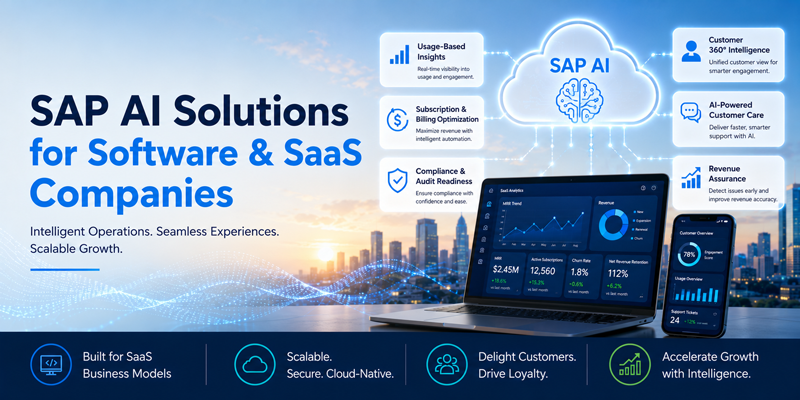
The transformative power of artificial intelligence (AI) is being felt across most industries, changing the way businesses run their operations, interface with customers, manage revenue, and much more. In sectors such as telecom, media, automotive, utilities, professional services, life sciences, medical devices, and software/SaaS, AI is becoming a game-changer for streamlining workflows, enhancing customer experiences, and optimizing financial and supply chain management. 

Read More

SAP Cloud ERP is Enabling the Future for the Utilities Industry

Wed, Jul 16, 2025 @ 02:54 PM / by David Fellers posted in CEO perspective, Thought Leadership, SAP Cloud ERP

The utilities industry is seeing a notable trend toward adopting cloud-based ERP solutions and advanced subscription management software to address changing business models, customer preferences, energy sharing practices, and complex compliance issues.

Read More

Waves of Change in the Media Industry are Enabled by SAP Cloud ERP Solutions

Mon, Jul 7, 2025 @ 06:57 AM / by David Fellers posted in media and entertainment, SAP Cloud ERP, industry solutions

The media industry is at a crossroads, with streaming services, evolving licensing models, and increasing M&A activity transforming the way content is created, distributed, and consumed. Revenue recognition challenges are rising as companies adopt more complex business models, while the rise of cloud ERP solutions is enabling companies to streamline their operations, ensure compliance, and adapt to new revenue streams. The convergence of these trends is driving the industry toward greater integration, flexibility, and data-driven decision-making, thereby reshaping the landscape for media companies and content consumers alike.

Read More
DSE Webcast
Download eBook - Transitioning to ASC 842: Why Robust Analytical Reporting Tools will be a must for all Entities

Subscribe to Email Updates

Recent Posts