.gif?width=320&height=80&name=7-logo-30years%20(1).gif "7-logo-30years (1)")

This is the newest installment in our industry-focused series within the broader SAP AI Insights collection. Building on four earlier posts covering SAP AI solutions for finance & compliance; project systems & supply chains; energy & datacenters; and telecom, this post focuses on software and Software-as-a-Service (SaaS), an industry that, in many ways, invented the modern recurring revenue playbook but is now being disrupted by the very technology it helped commercialize.
Key Trends Reshaping Software and SaaS
For over two decades, SaaS companies scaled on a fairly predictable formula: per-seat subscriptions, annual contracts, and net dollar retention driven by seat expansion. That formula is now under real pressure. Agentic AI can do the work of multiple human users, which means the "per-seat" unit of value is eroding just as the industry's cost base shifts toward compute, tokens, and model consumption. At the same time, buyers increasingly expect to pay for outcomes rather than access.
The result is one of the most significant repricing and re-architecting moments the software industry has seen since the shift from on-premise licenses to the cloud. This is exactly the kind of complexity where SAP AI-enabled solutions can help software and SaaS providers move faster and with more confidence.
Several converging trends are redefining how software and SaaS companies build, price, and monetize their products:
- The decline of pure per-seat pricing: As AI agents reduce the number of human users needed to get work done, seat count is becoming a weaker proxy for value, pushing vendors toward usage-based and outcome-based models.
- Hybrid pricing as the new default: Rather than abandoning subscriptions, most successful vendors are combining a base subscription with usage-based or outcome-based components, since pure usage-only models tend to grow more slowly than a hybrid base-plus-usage approach.
- Outcome-based and agent-based pricing: New tiers priced per resolution, per task, or per agent are emerging alongside traditional plans, particularly for AI-powered features and agents.
- Credit-based pricing as a bridge: Many vendors are introducing credit wallets to monetize AI features without fully re-architecting existing plans.
- AI-native architecture over AI bolt-on: Buyers increasingly favor products where AI is embedded in the core workflow rather than sold as a separate add-on tier.
- Vertical SaaS and consolidation: Industry-specific software is growing faster than horizontal tools, even as enterprises simultaneously consolidate overlapping point solutions to control cost and complexity.
Gartner has forecast that by 2030 a majority of businesses will prefer usage-based pricing over per-seat models. McKinsey research found that roughly 40 percent of IT buyers now name seat reduction as their primary lever for cutting software spend, a direct consequence of agentic AI absorbing work that once required a licensed user.
These shifts mean software and SaaS providers now need to support far more complex commercial models than a single tiered price list. This is driving the need for base subscriptions layered with metered API or compute usage, per-outcome charges for AI agents, credit pools shared across products and users, and usage-based overage billing, often all within the same customer contract.
How SAP AI-Enabled Solutions Help Software and SaaS Companies
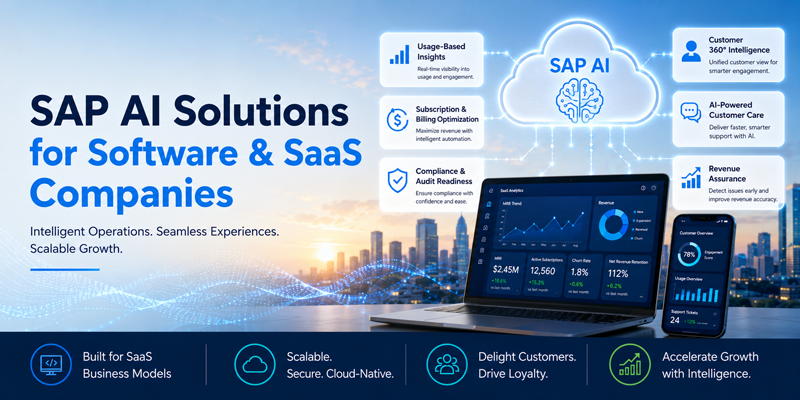
Intelligent Pricing, Packaging, and Monetization Design
Repricing a SaaS business is high-stakes work. SAP AI can help product and revenue teams model the impact of different pricing architectures by combining:
- Historical usage and consumption data by feature, workflow, and customer segment
- Churn, expansion, and renewal signals
- Competitive and market pricing intelligence
- Cost-to-serve data, including compute and AI inference costs
This allows finance and product leaders to simulate how shifting from per-seat to hybrid usage-plus-subscription pricing, or introducing an outcome-based AI agent tier, will affect adoption, revenue, and margin before it is rolled out broadly.
AI-Driven Customer Onboarding, Success, and Support
SaaS support and customer success functions are high-volume and directly tied to retention. In combination with SAP Subscription Order Management (SOM) and SAP Billing and Revenue Innovation Management (BRIM), SAP AI agents can enhance these functions with agents that:
- Guide new customers through setup, configuration, and activation
- Answer billing, plan, and usage-eligibility questions
- Triage and resolve common product issues
- Surface proactive recommendations when usage patterns suggest under-adoption or churn risk
As in other industries, SAP's AI-enabled self-service capabilities are designed to handle a large share of routine inquiries without human intervention, freeing customer success teams to focus on strategic accounts and expansion conversations.
Usage Monitoring, Anomaly Detection, and Consumption Intelligence
As pricing shifts toward usage and consumption, accurately capturing and validating usage becomes mission-critical. SAP AI can help by:
- Continuously monitoring usage and consumption events across products, APIs, and AI agent interactions
- Detecting anomalies, spikes, or irregular consumption patterns that may signal fraud, misconfiguration, or billing errors
- Validating usage records against contract terms before they flow into billing
- Flagging accounts approaching plan limits so customer success or sales can act before churn or dispute risk arises
SAP has already introduced AI-assisted usage anomaly detection within SAP Convergent Mediation, reflecting how central this capability is becoming as more revenue depends on accurately metered consumption.
Intelligent Subscription and Usage-Based Billing
Billing complexity grows quickly once a SaaS company mixes seats, usage, credits, and outcomes in a single contract. SAP AI in combinaton with and SAP Quote-to-Cash (QTC), can help by:
- Managing subscription, usage-based, credit, and outcome-linked charges within one unified billing model
- Automating billing events triggered by consumption thresholds, resolved outcomes, or credit depletion
- Supporting complex bundle logic, proration, discounts, and mid-cycle plan changes
- Ensuring accurate, auditable billing as pricing models evolve
For example, a SaaS provider offering a base subscription plus metered API usage and/or a per-resolution tracking plan can use SAP AI to keep telemetry, contract terms, and billing triggers synchronized so the offering scales without excessive manual reconciliation.
Revenue and Contract Management for Complex SaaS Offerings
Multi-element SaaS arrangements create revenue recognition and compliance challenges under ASC 606 and IFRS 15. Through integration with SAP Revenue Management and SAP Universal Revenue Recognition, SAP AI can support:
- Identifying and allocating value across multiple performance obligations within a single contract
- Applying revenue recognition rules consistently across subscription, usage, and outcome-based components
- Detecting billing exceptions, revenue leakage, and compliance risks
- Delivering analytics on contract performance, consumption trends, and profitability by plan or segment
As SAP's high-tech industry executive Patrick Maroney has noted, moving to a usage-based or subscription-based model "entails a fundamental change in your business model, which requires synchronization and native integration between commerce, configuration, engineering, pricing, quotation, finance, supply chain, billing/invoicing and entitlement management". SAP AI helps make that synchronization scalable rather than manual.
Retention, Expansion, and Renewal Intelligence
With acquisition costs rising and Net Dollar Retention now a defining SaaS metric, renewal and expansion intelligence is a major AI opportunity. Leveraging seamless integration throughout SAP S/4HANA, SAP AI agents can help by:
- Predicting churn risk based on usage decline, support activity, and engagement signals
- Identifying expansion and cross-sell opportunities from underused capacity or approaching usage limits
- Automating renewal workflows and flagging at-risk contracts for proactive intervention
- Modeling the revenue impact of migrating existing customers from legacy per-seat plans to new hybrid pricing
This turns retention from a reactive, dashboard-driven exercise into a proactive, AI-assisted motion embedded directly in commercial operations.
Example Use Case: Migrating from Per-Seat to Hybrid AI-Era Pricing
A representative scenario is a B2B SaaS company that has historically sold a per-seat subscription and now wants to introduce:
- A base subscription tier covering core functionality
- Metered usage charges for API calls and compute-intensive AI features
- A new outcome-based tier for an AI agent add-on, priced per resolved task rather than per seat
In this scenario, SAP AI can help the company forecast adoption and revenue impact across customer segments, monitor and validate consumption data in real time, automate billing across the blended subscription-usage-outcome model, and ensure revenue is recognized correctly across each performance obligation. It can also flag existing customers whose usage patterns suggest they would benefit from migrating to the new model, supporting a data-driven transition rather than a blanket repricing exercise.
How Bramasol Can Help
Bramasol's experience is especially relevant for software and SaaS companies because we have been a leader in tailoring SAP for the Digital Solutions Economy, helping clients operationalize subscription, usage-based, outcome-based, and other XaaS commercial models. Our packaged solutions for the high-tech and software sector bring together SAP Cloud ERP, SAP Billing and Revenue Innovation Management (including SAP Subscription Billing), Quote-to-Cash, revenue accounting, analytics, and finance transformation, with new AI enablement seamlessly embedded within each of these areas.
This matters because the challenge facing software and SaaS companies today is not simply adding AI features to existing pricing pages. The larger challenge is re-architecting commercial operations, pricing, billing, revenue recognition, and customer success workflows to keep pace with an industry where the underlying unit of value is shifting from seats to usage and outcomes in real time.
Bramasol's position at this intersection of SAP process expertise and recurring revenue transformation gives software and SaaS organizations a clear path to operationalize SAP AI in ways that support both commercial innovation and disciplined financial execution. In this next chapter of the software industry, the winners will not simply be the vendors who bolt AI onto existing plans. They will be the ones who use SAP AI to rebuild pricing, billing, and revenue operations around usage and outcomes at scale, and that is exactly the kind of transformation Bramasol is built to support.