.gif?width=320&height=80&name=7-logo-30years%20(1).gif "7-logo-30years (1)")

For fast-scaling mid-market companies, replacing an entry-level ERP (such as Quickbooks or Netsuite) should be viewed as much more than simply an accounting-system upgrade. In reality, it offers an important opportunity to establish a scalable operating foundation; one that connects finance, procurement, sales, supply chain, and planning around trusted, real-time business data for companies that are growing in breadth and sophistication.
GROW with SAP, built on SAP S/4HANA Cloud Public Edition, gives organizations a standardized cloud ERP platform that is purposely designed for this transition. With embedded AI capabilities and Joule, GROW helps companies move beyond fragmented processes while helping finance and operational teams work more efficiently from the moment they go live.
When a legacy ERP becomes a growth constraint
Many high-growth companies begin with systems that meet immediate needs: for example, QuickBooks for accounting, spreadsheets for forecasting, standalone tools for purchasing, separate applications for inventory, expense management, billing, and CRM.
That approach can work—until growth exposes the gaps.
CFOs and IT leaders most often see these warning signs first:
- Month-end close takes too long because reconciliations happen across disconnected systems.
- Finance teams depend on spreadsheets to consolidate data, manage approvals, or create management reporting.
- Revenue, margin, inventory, and cash positions are difficult to view in real time.
- Business units use different processes and data definitions, making expansion or acquisition integration harder.
- New locations, products, entities, or sales channels introduce more manual work rather than scaling up with automation.
- IT spends disproportionate amounts of time maintaining integrations, managing data exports, and supporting shadow processes.
The issue is not that the legacy system has suddenly failed. The issue is that it was never designed to become the digital core of a larger, more complex enterprise.
A modern cloud ERP should help leaders create a single source of truth, strengthen governance, automate routine work, and make decisions using always current information rather than month-old financial and operational data.
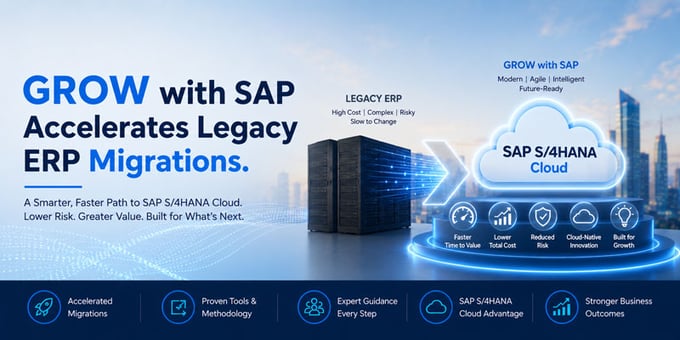
Why GROW with SAP fits the mid-market transition
GROW with SAP is SAP’s offering for organizations newly adopting cloud ERP, centered on SAP S/4HANA Cloud. It supports core processes including order-to-cash, procure-to-pay, record-to-report, financial management, and related business operations through a standardized cloud model.
For a company migrating from QuickBooks, spreadsheets, or disconnected entry-level software, that standardized approach matters. Rather than recreating years of workarounds, a GROW with SAP implementation provides an opportunity to evaluate processes against proven cloud ERP practices.
| Legacy ERP environment | GROW with SAP approach |
|---|---|
| Disconnected finance, inventory, billing, and procurement tools | Integrated processes built around a common ERP platform |
| Manual reconciliations and spreadsheet-based reporting | More consistent, real-time operational and financial visibility |
| Heavy reliance on custom workarounds | Proven standardized processes with a clean-core mindset |
| Limited scalability across entities, locations, and growth initiatives | Cloud architecture designed to support expansion and ongoing innovation |
| Periodic system upgrades that create disruption | SAP-managed cloud updates and always up-to-date software |
S/4HANA Cloud Public Edition is designed to provide embedded AI across core business processes, including finance, supply chain, HR, and sales. For leaders, this means the ERP decision is not only about replacing transactions; it is about building a platform that can support higher-quality decisions and more efficient execution over time.
AI should accelerate the migration—not complicate it
AI has the greatest value in an ERP migration when it helps teams reduce uncertainty, surface insights, and focus their time on decisions that require human judgment.
A disciplined migration still requires business-process design, data cleansing, change management, integration planning, and governance. AI does not eliminate those responsibilities. It can, however, help an organization move through them more efficiently.
During the migration from a non-SAP ERP to S/4HANA Cloud ERP, AI-enabled capabilities can support several high-value activities:
- Process discovery: AI can identify manual handoffs, duplicate effort, approval bottlenecks, and inconsistent workflows that should not be carried into the new environment.
- Data readiness: AI helps teams assess master-data quality, identify duplicate or incomplete records, and establish stronger ownership for customers, vendors, products, chart-of-accounts structures, and reporting dimensions.
- Faster finance execution: AI can support tasks related to billing, receivables, cash management, and financial management so finance can concentrate more time on exceptions, controls, and strategic analysis.
- User adoption: AI gives employees a more intuitive way to find relevant applications with AI agents and to get answers while learning new processes.
- Ongoing insight: AI agents move beyond static reports toward timely analysis of issues affecting cash, profitability, purchasing, and operational performance.
The key to migration success is to treat AI as part of an operating-model redesign; not as a feature to activate after go-live without clear use cases, ownership, or data discipline.
What Joule brings to S/4HANA Cloud
Joule is SAP’s AI solution for helping users interact with SAP business processes through natural language. In SAP S/4HANA Cloud, it helps users express requirements in natural language and find or navigate to commonly used applications for the next task.
For organizations whose employees are used to navigating multiple disconnected systems, this is significant. The transition to a new ERP often fails not because the software lacks functionality, but because users struggle to locate information, understand new workflows, and confidently act in the system.
Joule can help lower that friction.
Consider a finance leader preparing for a weekly cash review. Instead of moving between reports, spreadsheets, email threads, and point solutions, the transformational goal is a fully connected experience where teams can more quickly access relevant data, business context, identify exceptions, and focus on decisions.
Joule is available in S/4HANA Cloud and is integrated into SAP’s cloud ERP experience. This enables Joule to bring various AI assistants and agents together to streamline workflows, automate decisions, and provide connected intelligence across enterprise functions.
For C-suite leaders, the practical question is not, “Do we have AI?” Instead, it should be: "Where can AI reduce manual effort, improve decision speed, and strengthen the quality of execution without compromising data governance and control?"
That question should shape the ERP roadmap from the outset.
A better migration mindset: Transform, don’t transplant
The fastest path to cloud ERP value is rarely a one-for-one recreation of the old environment.
Companies moving from QuickBooks or fragmented legacy systems should resist the urge to reproduce every spreadsheet, custom approval, report, and workaround inside the new ERP. Those artifacts often reflect limitations in the prior technology stack, not enduring business requirements.
Instead, leadership teams should use the migration to make deliberate choices:
- Standardize the processes that differentiate least. Use proven practices for core finance, purchasing, approvals, and reporting wherever possible.
- Protect the clean core. Keep unnecessary customizations out of the ERP foundation so the organization can adopt future cloud innovations with less disruption.
- Prioritize data governance early. AI, analytics, automation, and reliable reporting all depend on accurate master and transactional data with built in governance.
- Define outcomes before features. Establish the KPIs that matter; such as days to close, forecast accuracy, working capital, order cycle time, margin visibility, or time spent on manual reporting.
- Plan adoption as a business initiative. The project is not complete at technical go-live. Finance, operations, sales, and IT teams need role-based training, process ownership, and a plan for continuous improvement.
SAP’s GROW methodology includes tools such as the Digital Discovery Assessment, SAP Central Business Configuration, SAP Cloud Application Lifecycle Management (ALM), and SAP Activate to support implementation, configuration, and project governance. This comprehensive SAP toolchain is designed to reduce time-to-value and minimize project costs, while GROW provides a predefined scope intended to support predictable deployment.
Questions CFOs and CIOs should ask now
Before selecting a platform or implementation approach, executive sponsors should align on a short set of strategic questions:
- Which finance and operational processes are holding growth back today?
- What data must be trustworthy and available in real time for executives to run the business?
- Where are teams using spreadsheets as unofficial systems of record?
- Which processes should be standardized rather than customized?
- What are the first AI use cases that would deliver measurable value after go-live?
- How will we measure user adoption, close-cycle improvement, reporting reliability, and operational efficiency?
- Who owns data quality, process governance, and continuous improvement after implementation?
The answers provide the business case for replacing a legacy ERP and the roadmap for realizing value from S/4HANA Cloud, embedded AI, and Joule.
Build the foundation for the next stage of growth
Replacing a legacy ERP is a pivotal decision for a growing mid-market company. Done well, it reduces finance complexity, improves real-time visibility, strengthens controls, and establishes the operating foundation needed to support new products, entities, markets, and acquisitions.
GROW with SAP provides a well-defined, smooth path for migration to SAP S/4HANA Cloud ERP for organizations ready to move beyond disconnected entry-level systems. Embedded AI and Joule add further value by helping users find information, navigate work, and streamline intelligent business processes.
Bramasol makes that transition more practical and predictable.
Through our quick-start, Qualified Partner Packaged Solution (QPPS), Bramasol gives mid-market organizations a defined scope, predictable investment, and structured path to SAP go-live in approximately 13 weeks. The approach is designed around the capabilities a scaling business needs now, while creating room to grow into more sophisticated processes, analytics, automation, and AI over time.
The strongest ERP migrations do not simply recreate legacy processes in a new system. They give finance, operations, and IT leaders a clean, scalable foundation for the next stage of growth; delivered with the speed, clarity, and business-focused guidance needed to turn cloud ERP investment into measurable value.