.gif?width=320&height=80&name=7-logo-30years%20(1).gif "7-logo-30years (1)")

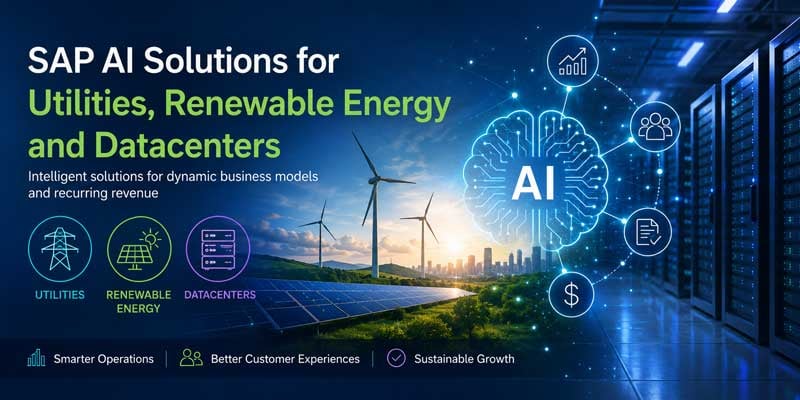
This Insights post is the first in a new set of industry-focused articles within the broader SAP AI Insights series. It looks at how SAP AI applies to three sectors where recurring revenue and complex monetization models are becoming central to growth: Utilities, Renewable Energy, and Datacenters.
Across Utilities, Renewable Energy, and Datacenters, the business models are often changing faster than traditional ERP technologies can keep up. What were once relatively straightforward product or service relationships are becoming far more dynamic, with subscription offerings, usage-based pricing, bundled services, outcome-based contracts, revenue sharing plans, and customer-specific billing arrangements redefining how value is delivered and monetized.
These shifts create major opportunities, but also increase complexity. As companies introduce energy sell-back programs, distributed generation models, virtual power plant participation, edge infrastructure services, and bundled managed offerings, they need more than automation alone. They need intelligent systems that can connect operational data, commercial terms, customer behavior, billing logic, and revenue compliance into a scalable execution model. That is where SAP AI-enabled solutions can play a critical role.
Utilities
The utilities industry is moving well beyond the traditional meter-to-cash model. Several major trends are reshaping the sector, including subscription-based services, personalized energy offerings, demand response programs, distributed energy resources, microgrids, virtual power plants, dynamic pricing, and customer sell-back of solar-generated power into the grid.
These trends are creating more sophisticated commercial relationships between utilities and customers. Instead of a single rate plan and a monthly bill, utilities now need to support time-of-use pricing, usage-based service plans, bundled energy and service offerings. Also many utilities are instituting entirely new models such as distributed battery storage programs, EV charging options, credits for energy contributions and energy sell-back programs. These dynamically changing service combinations increase the need for flexible billing, accurate revenue treatment, and real-time operational visibility.
SAP AI-enabled solutions can help utilities respond in several ways:
- Improving demand forecasting and pricing support by combining usage history, weather patterns, grid conditions, and customer behavior signals.
- Enhancing customer self-service and support with AI-driven assistance around billing, usage, service eligibility, and issue resolution, such as SAP Utilities Customer Self-Service Agent, which can reduce service costs by up to 90%.
- Strengthening predictive maintenance and asset monitoring across grids, substations, and field infrastructure using operational and IoT data.
- Providing flexibility and failover predictions to improve power uptime and minimize the impact of outages by having agents that trigger preventive maintenance.
- Increasing security and reducing infrastructure vulnerabilities by anticipating and modeling potential threats.
- Supporting distributed energy and dynamic tariff models by helping utilities manage more decentralized, data-rich service relationships.
For example, a utility could offer a bundled customer program that includes standard electricity service, rooftop solar participation, battery dispatch incentives, EV charging discounts, and sell-back credits. In that environment, SAP AI can help manage forecasting, exception handling, billing intelligence, and customer engagement across a far more variable revenue model than traditional utility billing.
Renewable Energy
Renewable energy companies are increasingly operating in a service-driven market rather than a pure generation market. Solar, storage, EV infrastructure, and decentralized energy programs are turning many providers into orchestrators of long-term customer relationships that combine physical assets, digital services, performance commitments, and recurring billing models.
This changes the revenue model significantly. Renewable providers may need to package equipment installation, power generation, storage, maintenance, monitoring, financing, grid participation, and incentive management into one offering. In some cases, total revenue comes from a mix of subscriptions, consumption charges, performance-based payments, market participation, or shared savings arrangements.
SAP AI-enabled solutions are especially relevant here because they can help mesh technical variability with commercial execution:
- AI-based renewable forecasting can combine weather, generation, and grid conditions to improve planning and dispatch.
- AI can help coordinate distributed energy resources such as solar, batteries, and EV chargers across decentralized service networks.
- Intelligent contract and billing support can help providers manage usage-based, subscription, and incentive-linked offerings with greater accuracy.
- Predictive maintenance can improve uptime and performance for renewable generation and storage assets.
A strong example is an energy-as-a-service model in which a provider bundles rooftop solar, battery storage, ongoing service, and system monitoring, into a recurring customer contract. SAP AI can help optimize production forecasts, automate operational exceptions, and support billing models that combine fixed fees, variable usage, and performance-based credits.
Datacenters
Datacenters are also shifting into the subscription and usage economy. As demand grows for AI infrastructure, distributed computing, edge capacity, and managed resiliency services, datacenter providers are moving beyond simple lease or colocation models toward more flexible and service-oriented commercial offerings.
This means providers increasingly need to support billing and revenue models built around reserved capacity, actual usage, power consumption, overages, uptime commitments, cooling, backup services, and bundled operational support. In distributed or edge datacenter environments, the overall complexity grows further because services may be delivered across multiple sites, each with different utilization, service levels, and commercial obligations. There are even some new experiments with distributing mini datacenters throughout new residential developments, which addresses some of challenges that require huge new power sources, but adds even more complexity for monitoring usage and revenue sharing.
SAP AI-enabled solutions can help datacenter operators by:
- Forecasting capacity, utilization, and energy demand across facilities to support pricing and planning decisions.
- Enabling more intelligent subscription and usage-based billing models across compute, storage, power, and service bundles.
- Improving infrastructure reliability through anomaly detection, predictive maintenance, and operational monitoring.
- Supporting revenue and contract management when offerings include multiple performance obligations, variable consumption elements, and SLA-based credits.
A representative use case would be a provider offering a bundled edge infrastructure service that includes rack space, committed power, burst capacity, cooling, remote management, and resiliency services across several distributed facilities. SAP AI can help align telemetry, contract terms, billing triggers, and financial treatment so those offerings can scale without excessive manual processing.
How Bramasol Can Help
Bramasol’s experience is especially relevant in these sectors because we have already been a leader in tailoring SAP for the Digital Solutions Economy, providing clients with support for recurring revenue models such as subscriptions, outcome-based offerings, XaaS, and other complex service models. We are experts in bringing together new AI-enablement to SAP Cloud ERP, Subscription Billing, revenue accounting, Quote-to-Cash, analytics, and finance transformation.
That matters because the challenge in Utilities, Renewable Energy, and Datacenters is not simply adopting bolt-on AI features. The larger challenge is turning new service models into executable, scalable business processes that connect operations, customer engagement, pricing, billing, compliance, and revenue recognition.
Bramasol’s experience at this key intersection of transformative technologies provides a clear opportunity for organizations that want to operationalize SAP AI in ways that support both innovation and disciplined business execution.
Summary
The opportunity across these industries is clear: recurring revenue and intelligent service models are becoming central to growth, differentiation, and customer retention. But those models only work when companies can manage the complexity behind them, from metering and usage signals to contract structures, billing events, operational exceptions, and financial compliance.
SAP AI has the potential to become a powerful enabler in that transformation by embedding intelligence directly into the business processes that matter most. For Utilities, Renewable Energy, and Datacenters, the winners will not simply be the companies that add AI. They will be the ones that use SAP AI to build smarter, more adaptive, and more scalable commercial operating models—and that is exactly the kind of transformation Bramasol is built to support.