.gif?width=320&height=80&name=7-logo-30years%20(1).gif "7-logo-30years (1)")

This new post in our SAP AI Insights series explores how SAP AI solutions are being applied within the telecommunications industry, where recurring revenue, complex monetization models, and rapidly evolving service offerings are becoming central to growth.
Throughout the telecom sector, business models are changing faster than traditional ERP technologies can keep up. What were once straightforward connections and monthly per-line charges are now dynamic ecosystems of subscription bundles, usage-based pricing, outcome-based contracts, revenue sharing plans, and customer-specific arrangements. Companies are offering 5G/6G services, IoT connectivity, cloud communications, managed security, edge computing, and digital content platforms—all wrapped in flexible, recurring revenue models.
These shifts create major opportunities, but also increase complexity. As telecom providers introduce new services, layered bundles, and customer-specific pricing, they need more than automation alone. They need intelligent systems that can connect operational data, commercial terms, customer behavior, billing logic, and revenue compliance into a scalable execution model.
This is where SAP AI-enabled solutions can play a critical role.
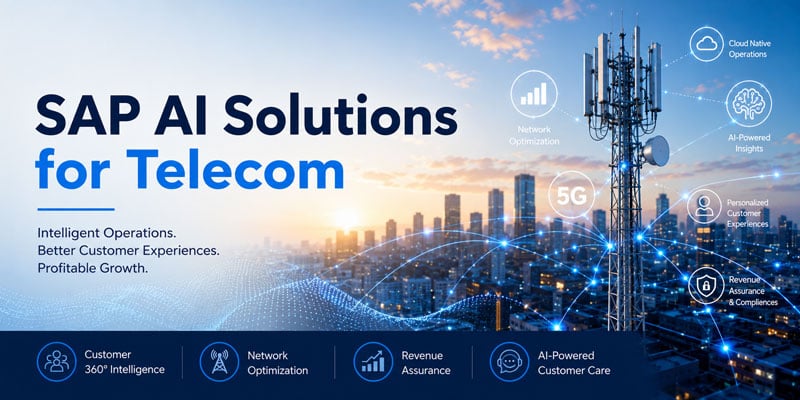
Key Trends Reshaping Telecom
Several major trends are redefining how telecom companies operate and monetize:
- Subscription and bundling evolution: Moving from single-line plans to multi-service bundles combining connectivity, cloud, security, and digital content.
- Usage-based and outcome-based models: Charging based on actual consumption (data, bandwidth, IoT events) or outcomes (uptime, latency guarantees).
- 5G and edge services: Monetizing new network edge capabilities with tiered SLAs, burst capacity, and specialized use cases for enterprises.
- IoT and industry solutions: Offering connectivity-plus platforms for logistics, manufacturing, robotics, healthcare, and more.
- Digital transformation of customer engagement: AI-driven self-service, predictive support, and personalized offers.
- Network optimization and automation: Using AI to predict failures, optimize traffic, and manage assets more efficiently.
These trends create more sophisticated commercial relationships between telecom providers and customers. Instead of a single rate plan and a monthly bill, providers now need to support time-of-use pricing, usage-based service plans, bundled connectivity, custom service offerings, and outcome-based contracts tied to performance metrics.
How SAP AI-Enabled Solutions Help Telecom
SAP AI-enabled solutions can help telecom providers respond to these shifts in several concrete ways:
1. Intelligent Demand Forecasting and Pricing Support
Telecom providers can improve demand forecasting and pricing support by combining:
- Historical usage data
- Network traffic patterns
- Customer behavior signals
- Market and competitive data
SAP AI agents can help model how different pricing strategies, bundle configurations, or capacity upgrades will impact adoption, churn, and revenue. This enables more dynamic, data-driven pricing and the ability to offer custom designs rather than relying on static, one-size-fits-all plans.
2. AI-Driven Customer Self-Service and Support
Telecom customer operations are high-volume and cost-intensive. SAP AI can enhance customer self-service and support with agents that:
- Answer billing and usage questions
- Explain plan options and eligibility
- Troubleshoot common service issues
- Guide customers through onboarding and configuration
For example, SAP’s AI-enabled customer self-service agents can reduce service costs significantly by handling routine inquiries and resolving issues without human intervention. This improves customer experience while lowering operational expenses.
3. Predictive Maintenance and Network Asset Monitoring
Telecom networks rely on vast physical and virtual infrastructure. SAP AI can help by:
- Analyzing operational and IoT data from network equipment
- Detecting anomalies and predicting failures before they occur
- Recommending maintenance actions and spare parts needs
- Coordinating field crews and optimizing schedules
This leads to improved network uptime, reduced emergency repairs, and better resource utilization.
4. Intelligent Subscription and Usage-Based Billing
As telecom providers move into more complex service models, billing becomes a critical challenge. SAP AI can help by:
- Managing usage-based, subscription, and outcome-linked offerings with greater accuracy
- Automating billing events triggered by network usage, SLA breaches, or performance metrics
- Supporting complex bundle logic, discounts, and promotions
- Ensuring revenue compliance and proper accounting treatment
For example, a provider offering a bundled enterprise solution that includes 5G connectivity, edge compute, managed security, and SLA-based performance credits can use SAP AI to align telemetry, contract terms, billing triggers, and financial treatment so those offerings scale without excessive manual processing.
5. Revenue and Contract Management for Complex Offerings
Telecom providers increasingly offer multi-component services with variable consumption elements and SLA-based obligations. SAP AI can support:
- Contract negotiation and configuration for complex service agreements
- Revenue recognition and compliance across multiple performance obligations
- Detection of billing exceptions and revenue risks
- Analytics on contract performance, utilization, and profitability
This helps providers manage risk, improve compliance, and ensure that complex offerings are monetized correctly.
6. Network Optimization and Operational Intelligence
SAP AI can also improve operational efficiency by:
- Forecasting capacity, utilization, and traffic patterns across networks
- Identifying inefficiencies and suggesting optimization strategies
- Supporting dynamic resource allocation in 5G and edge environments
- Enabling real-time monitoring and anomaly detection
- Monitoring security risks and modeling vulnerabilities
This leads to more resilient networks, better service quality, and more efficient use of infrastructure investments.
Example Use Case: Bundled Enterprise 5G and Edge Service
A representative use case would be a telecom provider offering a bundled enterprise service that includes:
- 5G connectivity with tiered SLAs
- Committed and burst edge compute capacity
- Managed security and monitoring
- Resiliency and backup services
In such a scenario, SAP AI can help:
- Forecast demand and capacity needs
- Automate operational exceptions and alerts
- Support billing models that combine fixed fees, variable usage, and performance-based credits
- Ensure revenue is recognized and reported correctly across multiple components
This allows the provider to scale sophisticated offerings without relying on heavy manual processes.
How Bramasol Can Help
Bramasol’s experience is especially relevant in the telecom sector because we have been a leader in tailoring SAP for the Digital Solutions Economy, providing clients with support for recurring revenue models such as subscriptions, outcome-based offerings, XaaS, and other complex service models. We are experts in bringing new AI-enablement to SAP Cloud ERP, Subscription Billing, revenue accounting, Quote-to-Cash, analytics, and finance transformation.
That matters because the challenge in transforming the telecom industry is not simply adopting bolt-on AI features. The larger challenge is turning new service models into executable, scalable business processes that mesh together operations, customer engagement, pricing, billing, compliance, and revenue recognition.
Bramasol’s experience at this key intersection of transformative technologies provides a clear opportunity for organizations that want to operationalize SAP AI in ways that support both innovation and disciplined business execution. In telecom, the winners will not be the companies that simply add AI. They will be the ones that use SAP AI to build smarter, more adaptive, and more scalable commercial operating models—and that is exactly the kind of business transformation Bramasol is built to support.