.gif?width=320&height=80&name=7-logo-30years%20(1).gif "7-logo-30years (1)")

In our initial Insights post in this series, SAP Sapphire 2026: Turning AI into Business Execution, we examined SAP’s game-changing AI announcements from Sapphire: AI is no longer just a standalone innovation story, but a practical enterprise capability that is already being embedded seamlessly into business processes, data, governance, and cloud ERP environments.
Then, in our most recent post, SAP AI Usage Scenarios for Finance, Compliance and Quote-to-Cash, we began drilling down to the line-of-business level by showing how AI can create measurable value in finance operations, compliance, and revenue processes.
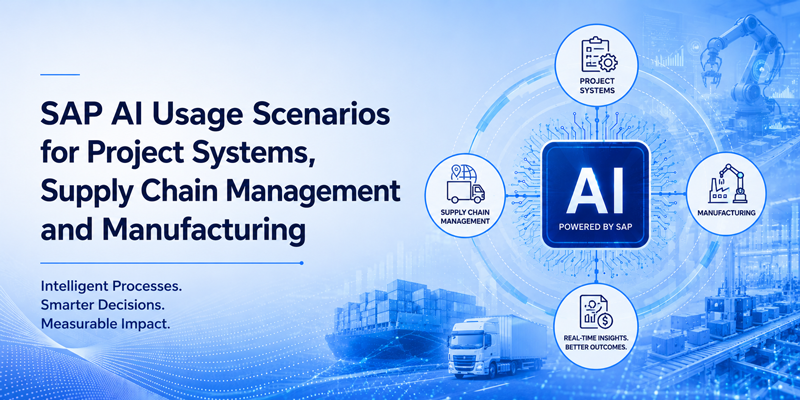
This new installment continues that drilldown progression by focusing on three additional operational domains where SAP Business AI can drive meaningful execution improvements: Project Systems, Supply Chain Management, and Manufacturing. These are areas where organizations often face significant planning complexity, operational volatility, and potential high costs from delays, downtime, shortages, or poor visibility, making them strong candidates for practical, process-driven AI adoption.
Going beyond AI hype
The most important lesson from SAP’s current AI direction is that value comes from applying intelligence where it improves execution, not from deploying AI for its own sake. The earlier posts in this series stress the point that companies should leverage built-in AI processes where improved speed, accuracy, resilience, or control will produce measurable business outcomes and quantifiable value.
That is especially relevant in Project Systems, Supply Chain, and Manufacturing because these functions operate at the intersection of planning and real-world variability. When AI is embedded correctly, it can help organizations identify risks sooner, make better operational decisions, and respond faster to changing conditions across the enterprise.
Project Systems
Project-based organizations are constantly balancing deadlines, budgets, resource constraints, supplier dependencies, and contractual commitments. AI can improve project execution by helping teams move from reactive issue management to earlier risk detection, smarter planning, and more consistent decision support.
Some of the strongest SAP AI usage scenarios in Project Systems include:
- Avoid costly project delays by leveraging predictive identification of schedule, cost, and resource risks based on historical project patterns and intervening before they become a problem.
- Decrease the likelihood of large forecast to actual surprises through continuous forecast updates based on real-time results and leading indicators.
- Reduce time for reporting and audits by accurately assigning costs and resources to projects or partnerships through AI Driven automated invoicing agents
A practical example would be a capital-intensive project environment where a late supplier delivery, scope change, or engineering issue can potentially threaten delivery commitments. AI can help surface those risks earlier by connecting schedule signals, material dependencies, and operational data so project leaders can intervene before a small issue turns into a major project overrun.
Practical rollout steps:
- Start with project forecasting, milestone tracking, and exception visibility in one business unit or portfolio.
- Apply AI to project documents and status reporting where teams are spending heavy manual effort.
- Expand into resource optimization and risk recommendations once project structures and reporting data are consistent enough to support trusted outputs.
The real advantage is not necessarily full project automation. It is better foresight, faster issue resolution, and stronger execution discipline inside complex delivery environments.
Supply Chain Management
Supply chain is one of the clearest opportunities for SAP AI because it is shaped by constant variability in demand, supply, logistics, and inventory. SAP solutions enable AI-driven decision support across supply chain and manufacturing processes, including capabilities aimed at planning responsiveness, operational resilience, and disruption management.
The most practical usage scenarios include:
- Improve demand sensing and forecasting using both internal and external signals.
- Enhance inventory optimization to reduce excess stock while protecting customer service levels.
- Reduce risk with AI supplier and procurement risk monitoring to identify likely disruptions earlier.
- Lower costs with logistics optimization across transportation, fulfillment, and exception handling.
- Improve operational visibility that helps planners detect and prioritize emerging issues before they escalate.
For example, consider a high-tech electronics company dealing with a combination of scarce components, long lead times, and multi-tier supplier dependencies. In those environments, AI can help planners rebalance inventory, prioritize scarce materials, and adjust supply plans when a semiconductor shortage or specialized component delay threatens plant output or customer delivery commitments.
Practical rollout steps:
- Begin with one high-impact use case such as constrained-material visibility, supplier delay prediction, or inventory rebalancing.
- Integrate AI recommendations into existing planning and procurement workflows so teams can act on exceptions quickly.
- Expand into scenario modeling and optimization after supply, inventory, and supplier data quality have improved enough to support broader decision automation.
In supply chain, the biggest gains usually come from helping planners make better decisions faster. That makes AI most valuable when it strengthens real operating workflows rather than being implemented as a separate analysis overlay.
Manufacturing
Manufacturing is another major area where SAP AI is becoming operationally more meaningful, especially in maintenance, quality, production planning, and plant performance. SAP AI-enabled innovations support key areas such as visual inspection, anomaly detection, manufacturing efficiency, and better use of machine and operational data across the supply chain landscape.
The most valuable manufacturing use cases include:
- Enable predictive maintenance based on sensor data and asset performance patterns.
- Enhance AI-assisted quality inspection using computer vision and defect detection.
- Create smarter production scheduling based on demand, machine availability, and capacity constraints.
- Improve energy and resource optimization to reduce waste and operating costs.
- Enable digital manufacturing assistants that support operators and supervisors with real-time recommendations.
A representative example would be a manufacturer running high-value production lines where unplanned downtime, quality escapes, or bottlenecked equipment can quickly affect throughput and margins. AI can help identify abnormal operating conditions sooner, flag likely failure patterns, and detect quality issues earlier, reducing costly disruptions while improving yield and schedule adherence.
Practical rollout steps:
- Start with a focused use case such as predictive maintenance on critical assets or AI-assisted inspection on a constrained production line.
- Feed AI alerts into existing maintenance, quality, and supervisory workflows so responsive actions happen inside current plant processes.
- Scale into broader planning and orchestration use cases once teams have validated the data, response model, and measurable business impact.
Manufacturing AI succeeds best when it is tied to KPIs such as downtime, scrap, throughput, first-pass yield, and schedule adherence; essentially starting where measurable execution value is clear, then scaling from there.
Summary
As organizations evaluate deploying SAP Business AI solutions beyond initial finance-first implementations, the strongest opportunities will come from applying it to operational processes where better execution improves delivery, resilience, and plant performance. Project Systems, Supply Chain Management, and Manufacturing all fit that profile because they combine complex decisions, real-time variability, and direct business impact.
For Bramasol clients and prospects, the opportunity is not simply to experiment with AI, but to align SAP AI capabilities with their unique industry-specific processes and measurable outcomes. In automotive, high tech, semiconductors, electronics, medical devices and other manufacturing environments in particular, practical AI adoption can help organizations improve visibility, reduce disruption, and build a more responsive and scalable operating model