.gif?width=320&height=80&name=7-logo-30years%20(1).gif "7-logo-30years (1)")

Our previous Insights post provided a high-level overview of SAP Sapphire 2026 announcements on Turning AI into Business Execution. In this new post, we're taking a deeper dive into the practical implications for line-of-business areas - specifically regarding finance, compliance and quote-to-cash.
The most important Sapphire 2026 takeaway is not that every company should immediately deploy agents everywhere. The real takeaway is that leaders must map AI opportunities to the business processes where better execution will create measurable value.
From a Bramasol perspective, among the first places to apply these new capabilities are Finance, Compliance, and Quote-to-Cash, because those areas offer clear ROI, strong control requirements, and measurable cycle-time gains,
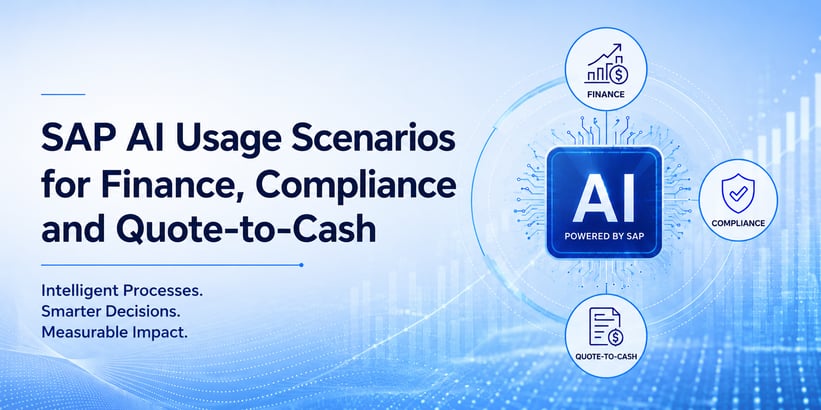
Going Beyond AI Hype with Practical Usage Scenarios
SAP’s new AI capabilities are much more than just a broad AI transformation slogan; but instead are a set of strategically targeted tangible application-ready improvements across specific business processes.
There are three key trends that are driving these opportunities for rapidly reaping measurable business returns for companies that move fast with the implementation of new SAP AI capabilities.
-
First, AI is moving from productivity enhancement to workflow execution, with Joule and related agents becoming more deeply embedded across SAP’s portfolio.
-
Second, data and applications are being treated as a single strategy, which is essential for trustworthy AI and better decision-making.
-
Third, SAP’s ecosystem is becoming more partner-driven and industry-specific, especially in areas like finance, compliance, QTC, supply chain, manufacturing and other front-line operational arenas.
It is now clear that the market wants solutions tailored to business processes that bring all the pieces together to hyperscale their competitiveness, value to customers, and bottom line results; not just generic AI demonstrations.
Finally, there is a growing sense of urgency because organizations that delay modernization will risk falling behind their competitors that are already using cloud ERP and AI to create faster, smarter operations.
Finance
For finance teams, AI should be evaluated through the lens of accuracy, rapid close-speed, forecasting quality, exception management, and confidence in the numbers. SAP’s Autonomous Close Assistant points to a future where AI can help automate journal entries, reconciliation, and error resolution inside controlled finance processes.
Compliance is where AI adds value by reducing manual monitoring while improving control consistency. SAP AI-powered GRC Governance Assistant capabilities are useful for control testing, regulatory monitoring, third-party screening, and compliance reporting, with machine learning and natural language processing (NLP) helping teams detect anomalies and respond faster to new requirements. This is a clear shift from reactive audit preparation to continuous compliance.
SAP AI solutions help finance teams improve forecasting, accelerate close, automate invoice and expense processing, and strengthen cash visibility. That makes Finance the natural starting point for operational AI because the work is data-rich, repetitive, and highly sensitive to accuracy.
A practical rollout should begin with three steps:
- Automate routine transaction review and exception handling.
- Use predictive analytics to improve cash and revenue forecasting.
- Add AI-driven insights to support close, working capital, and risk decisions.
The key is to start with high-volume tasks that are draining your finance teams’ time, then expand into decision support once the data foundation is stable.
Bramasol’s Finance-First S/4HANA Transformation methodology starts with assuring a foundation of process excellence and data readiness. Incorporating SAP AI solutions into the Finance-First journey can accelerate the close process and improve insights, but only if the underlying chart of accounts, master data, revenue events, billing data, and controls are ready to support automation.
Compliance
Compliance is where AI hype must meet reality. In key areas such as revenue recognition, lease accounting, treasury, and statutory reporting, “almost right” is not good enough. SAP CEO Christian Klein made that point directly at Sapphire, stating that for mission-critical customer processes, “almost right” is not acceptable and that AI agents must be anchored in business processes, data, and governance to deliver accurate, compliant, and secure outcomes.
The best-fit use cases in compliance include:
- Continuous monitoring of transactions for exceptions or policy violations.
- Automated review of regulatory updates and mapping them to internal controls.
- Faster evidence collection and audit reporting across SAP environments.
For organizations in regulated industries, this is especially valuable because it reduces both audit fatigue and control risk.
Historically, Bramasol has long been the leader in revenue recognition and compliance, including ASC 606 and IFRS 15, by helping guide the development of SAP Universal RevRec solutions and tailoring them to a wide range of clients' complex compliance scenarios.
As AI becomes more embedded in finance processes, companies will need to AI-enable compliance with the same discipline we are already helping them apply today, such as controls, traceability, auditability, and governance by design.
Quote-to-cash
Quote-to-cash is one of the most important areas for AI-enabled business execution because it connects customer intent to monetization. In recurring revenue subscriptions, usage-based scenarios, and bundled offerings, the quote-to-cash process spans configuration, pricing, contracting, order management, billing, invoicing, revenue recognition, collections, and reporting.
Quote-to-Cash also is one of the strongest AI opportunity areas because it combines sales productivity, pricing, credit, billing, and revenue recognition in one flow. SAP’s AI use cases include predictive analytics, dynamic pricing, recommendation engines, natural language processing (NLP) for customer inquiries, quote generation automation, risk assessment, and credit scoring. Bramasol’s perspective is that QTC is where AI can directly improve revenue velocity and reduce leakage.
The highest-value applications are:
- Smarter quote generation based on customer history, margin rules, and deal context.
- Dynamic pricing and discount guidance to protect profitability.
- AI-assisted risk and credit checks before order acceptance.
- Better automation of billing and revenue recognition for recurring and hybrid models.
Bramasol is the leader in implementing SAP quote-to-cash-to-compliance solutions for the subscription and Digital Solutions Economy, including SAP Cloud ERP, SAP Subscription Billing, Universal Revenue Recognition, and value-added Bramasol IP. This type of integrated view is exactly what AI needs in order to take users beyond traditional processes that were focused on isolated tasks.
The practical opportunity in QTC is to use AI to improve flow integration across the entire quote-to-cash lifecycle. This can deliver faster quote validation, smarter exception detection, better billing accuracy, revenue treatment recommendations, and/or proactive alerts when a process step could create downstream compliance risk.
Summary
As organizations evaluate how to leverage SAP Business AI across finance, compliance, and quote-to-cash processes, success depends on more than technology alone. Bramasol combines deep expertise in SAP Finance, Revenue Accounting, Treasury, Compliance, and Quote-to-Cash solutions with practical AI and S/4HANA implementation experience, plus deep business and industry knowledge, to help companies identify high-value use cases and accelerate adoption.
From automating financial operations and enhancing compliance monitoring to optimizing subscription-based and recurring revenue models, Bramasol helps organizations unlock the full potential of SAP AI within SAP S/4HANA Cloud, SAP Business Suite, and SAP's expanding portfolio of AI-enabled applications. By combining industry best practices with proven SAP expertise, this enables businesses to improve decision-making, increase operational efficiency, strengthen governance, and drive measurable business outcomes from their AI investments.
Watch for the next installment in this Insights series, where we will dive into SAP AI Usage Scenarios on Project Systems, Supply Chain Management, and Manufacturing.