

If you have been following this Insights series on SAP AI, you probably have noticed a recurring theme. Whether the topic was autonomous audits, year-end close or, most recently, continuous planning in FP&A, nearly every post has ended with the same caution: AI only works if the foundation is ready.
In this post, we want to make that foundation the main topic. Every SAP AI capability we have discussed, from closing agents to planning assistants, depends on the same things: clean master data, a well-designed chart of accounts, and data that is harmonized across systems and entities. Without those, even the most advanced agent will produce answers that are fast, confident and wrong.
This is the uncomfortable truth that we share with clients: your AI strategy is really a data strategy. And for most organizations, the data strategy is further behind than they think.
AI Exposes Every Shortcut in Your Data
The research on this is remarkably consistent:
- A survey of 515 US-based AI decision-makers found that only 5% of organizations believe their data is largely ready for AI, and only 29% have completed a formal data audit and remediation plan. In the past 12 months, 37% paused, scaled back or abandoned an underperforming AI initiative.
- OneStream's Forward Finance Index, a study of 1,300 CFOs and finance leaders, found that 71% are confident in their ability to provide trusted data, but only 40% report full transparency in financial reporting data, and only 6% qualify as ready to scale AI.
- Gartner predicted that through 2026, organizations would abandon 60% of AI projects unsupported by AI-ready data. Looking ahead, Gartner expects that by 2028, 75% of large-scale autonomous business initiatives will stall mainly because of gaps in data foundations and data talent.
This gap between confidence and transparency is especially telling. Most finance leaders believe their data is trustworthy because their people know how to work around its problems. But AI does not know those workarounds. As one executive in the research put it, "AI exposes every shortcut you've ever taken with your data."
A common reaction to this problem is to move everything into a data lake and let AI sort it out. In finance, that approach rarely works.
Finance data is not just numbers. Its meaning depends on context: which legal entity, which accounting standard, which revenue policy, which approval rule, which time period. A posting to a revenue account means something different under a usage-based contract instead of under a fixed subscription. An intercompany invoice is only useful if both entities map it the same way.
When AI agents lack that context, they guess or hallucinate. SAP cites a 2026 VentureBeat survey in which 68% of enterprises traced a "confident but wrong" agent answer to missing or inconsistent business context in the previous six months.
That is why SAP's approach focuses as much on business meaning as on data storage. The SAP Knowledge Graph encodes business processes, such as the chain from purchase requisition to approval, purchase order, goods receipt, invoice verification and payment, into a machine-readable map. Agents follow that governed map instead of inferring relationships from patterns in historical data.
The Three Foundations That Matter Most
In our client work, data readiness for AI in finance comes down to three foundations.
1. Master data. Customers, suppliers, products, materials, contracts and cost objects are the nouns of every business process. If the same customer exists three times under slightly different names, an AI collections agent will treat it as three customers. If product master data does not reflect how offerings are actually priced and bundled, AI cannot reliably support billing, revenue recognition or margin analysis. Duplicate, incomplete or outdated master data is the single most common reason we see AI pilots underperform.
2. The chart of accounts. The chart of accounts is the vocabulary of finance. Many organizations, especially those that have grown through acquisition, run with multiple charts across entities, which may have inconsistent account usage. They also may have years of accounts that were created for one-off needs. Humans manage this through mapping tables and institutional knowledge. AI agents need a single, well-structured, consistently used chart of accounts, with clear rules about what belongs where. A rationalized chart of accounts is one of the highest-return investments a finance team can make before deploying AI.
3. Harmonized data across systems and entities. Even with good master data and a clean chart of accounts, AI needs a consistent view of data that lives in ERP, billing, CRM, procurement, planning and non-SAP systems. That means common definitions for key measures, such as what counts as bookings, revenue, churn or a customer, and consistent hierarchies for entities, products, regions and cost centers. The FP&A Trends survey we cited in our previous post found that FP&A teams still spend 47% of their time collecting and validating data. That figure is a direct measure of how much harmonization is still missing.
What SAP Business Data Cloud Changes
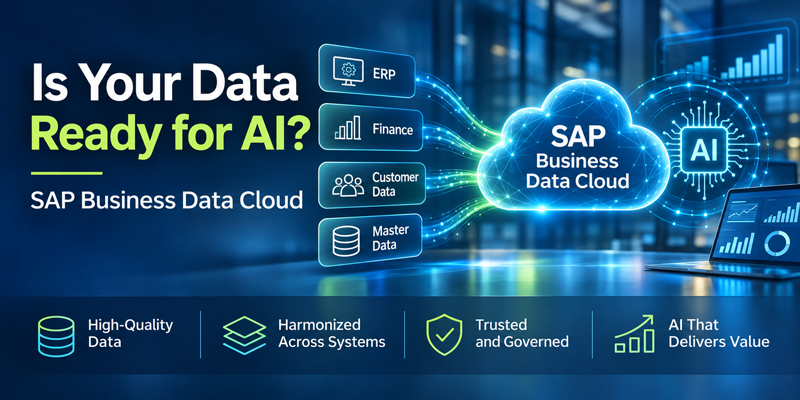
SAP Business Data Cloud (BDC) is SAP's answer to the data foundation problem, and it has evolved quickly over the past year. The key ideas are:
- Data products instead of data extracts. BDC organizes data into governed data products enriched with business semantics, with the SAP Knowledge Graph mapping relationships across them. The goal is to reduce the cost and complexity of extracting and replicating SAP data while keeping its business context intact.
- Master data as a governance layer. SAP Master Data Governance in BDC is the governance layer of the business data fabric, creating a "golden record for every domain". This enables matching, merging, and continuous data-quality monitoring. The new SAP Reltio acquisition adds AI-based entity resolution to match and reconcile records across SAP and third-party systems, making trusted profiles available as governed data products for Joule and Joule Agents.
- Open access without endless copies. BDC Connect enables zero-copy data sharing with Databricks, Snowflake, Google, AWS and Microsoft, and SAP's completed acquisition of Dremio adds the ability to query SAP and non-SAP data in real time without moving it.
- Business context for agents. At SAP TechEd in October, SAP announced that the SAP Knowledge Graph will incorporate customer-specific SAP and non-SAP sources, and introduced the SAP Business Data Cloud Ontology Manager for curating reusable, domain-specific business context.
As with every topic in this series, timing matters. According to SAP's TechEd news guide, the Ontology Manager beta is planned for November 2026, while the expanded Knowledge Graph features, native lakehouse capabilities, Joule Studio integration with BDC data products and SAP Reltio data product capabilities are all planned for Q1 2027. That makes the next few months an ideal window to get the underlying data ready, so it is in shape when these capabilities arrive.
A Practical Data-Readiness Checklist
Data readiness does not have to be a multi-year program before any AI value appears. The most effective approach ties data work directly to the AI use cases you want to pursue. Gartner's guidance follows the same logic, starting with aligning data to specific AI use cases and treating readiness as an ongoing practice rather than a one-time project.
For finance teams, we recommend six practical steps:
- Start from the use case. Pick the two or three AI scenarios you most want in 2027, whether that is intercompany matching, collections, forecasting or revenue analytics, and identify exactly which data each one depends on.
- Profile the data that matters. Measure duplicates, missing fields, inconsistent coding and stale records in the master data domains that those use cases touch. Use real numbers, not impressions.
- Rationalize the chart of accounts. Retire unused accounts, consolidate duplicates, document posting rules and align account usage across entities.
- Agree on definitions. Get finance, sales and operations to agree on what key terms mean, and document them so that both people and agents can use them.
- Assign data ownership. Every critical master data domain needs a named business owner, just as every AI agent does.
- Monitor continuously. Data quality decays. Build ongoing monitoring into the process rather than relying on periodic cleanup projects.
Bramasol's Finance-First S/4HANA Transformation methodology has always started with process excellence and data readiness. We built it that way long before AI agents became mainstream, because a clean chart of accounts, governed master data and harmonized revenue and billing data are what make any finance system work well.
AI has simply raised the stakes. In our experience, the organizations getting the most value from SAP AI are not necessarily the ones with the most sophisticated AI strategy. They are the ones that did the unglamorous work first: rationalizing accounts across entities, cleaning up customer and contract master data, aligning product structures with how offerings are actually sold and billed, and connecting subledger data into a consistent finance view.
Our deep experience across SAP Finance, Revenue Accounting, Subscription Billing, Lease Accounting, Treasury and Quote-to-Cash means we know where finance data problems tend to hide, particularly in the contract, billing and revenue data that feeds the general ledger. That is often where the biggest gap between "good enough for people" and "good enough for AI" lives.
The most important question about SAP AI is not which agent to deploy first. It is whether your data is ready to support it. Master data, the chart of accounts, and harmonized data across systems and entities are the real prerequisites for every AI capability we have covered in this series.
SAP Business Data Cloud provides a strong and rapidly maturing foundation, with governed data products, master data governance, open data sharing and growing business context for agents. But the platform cannot clean up years of inconsistent data on its own. That work still requires clear ownership, practical priorities and finance expertise.
Bramasol combines deep expertise in SAP Finance, Revenue Accounting, Treasury, Compliance and Quote-to-Cash with practical AI and S/4HANA implementation experience to help organizations assess their data readiness, fix what matters most, and build the foundation that makes SAP AI work.