

Our most recent Insights post, Year-End Close with SAP AI: What to Automate Before December 31, focused on getting the books closed faster and with stronger evidence. But a faster close is only half of the value equation. The other half is what finance does with those numbers once they are final, such as planning, forecasting, explaining variances and helping leadership decide what to do next.
That is the job of Financial Planning & Analysis (FP&A), and it is one of the areas where SAP AI is changing fastest. It is also an area where many organizations are feeling the most pressure right now, because 2027 budgets and forecasts are being built in an environment of tariff volatility, shifting demand, new AI-driven pricing models and persistent uncertainty about interest rates and growth.
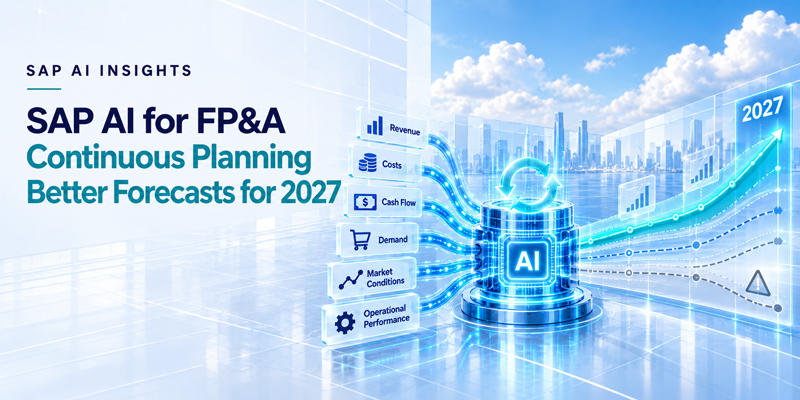
From a Bramasol perspective, FP&A leaders need to think along two timelines at once. Over the long term, SAP AI makes it possible to move from a periodic, calendar-driven cycle to continuous business planning. In the near term, there are practical improvements finance teams can make for the 2027 planning cycle using capabilities that are already in place.
FP&A Still Spends Too Much Time on Data, Not Decisions
The core challenges in FP&A have not changed much in years. The 10th annual FP&A Trends Survey, with 475 respondents in 2026, found that FP&A teams spend 47% of their time collecting and validating data, but only 19% rate their data quality as advanced, and just 11% have real-time access to data.
At the same time, expectations are rising quickly. The same survey found that 98% of respondents believe AI will affect their role over the next few years, although only 15% expect to be using AI agents within the next six months. When webinar participants were asked to name their weakest area of AI readiness, process design came first at 40%, ahead of data quality at 30%.
The broader finance picture is similar. At this year's Gartner Finance Symposium, Gartner reported that 59% of finance functions were actively using AI in 2025, while its 2026 Finance AI Report Card gave high marks for adoption and experimentation but low marks for scaling use cases into measurable business value.
The message is consistent: AI technology is arriving faster than the processes and data foundations, which are needed to optimize its use.
SAP's Planning Architecture Now Runs at Two Speeds
SAP has reshaped its planning portfolio around the idea that different planning horizons need different tools.
- SAP Analytics Cloud for planning remains the foundation for structured strategic and tactical planning, supporting budgeting, forecasting, variance analysis and scenario simulation over mid- to long-term horizons. Its predictive planning capability uses automated machine learning to turn historical data into forecasts and to automate forecast updates.
- SAP Enterprise Planning, introduced at Sapphire 2026, adds an agentic planning layer on top of SAP Analytics Cloud and SAP Business Data Cloud. It is built around a "sense, reason, act" model, in which embedded Joule Agents interpret internal and external signals, model their impact on KPIs, simulate scenarios, recommend actions and update plans when decisions are made.
- The Financial Planning Assistant orchestrates specialized agents for forecasting, variance analysis, market sentiment, model creation and conversational planning, running on governed SAP data, models and controls.
- New forecasting models are extending the foundation. At SAP TechEd, SAP introduced SAP-RPT-TS (Relational Prediction Transformer for Time Series) , a model designed to provide out-of-the-box forecasting with less data preparation and model training. It is pre-trained to return both point forecasts and prediction intervals using a process known as zero-shot forecasting, which is a machine learning approach that predicts future data points on completely unseen datasets or domains without requiring task-specific fine-tuning, retraining, or parameter adjustment.
A note on timing. SAP is planning general availability of both SAP Enterprise Planning and the Financial Planning Assistant for Q4 2026, and SAPinsider notes that SAP's finance AI rollout is now scheduled to be released by product capability and edition, with releases extending into 2027. Before building a 2027 planning process around any specific agent, organizations should confirm its availability for their SAP deployment environment.
The Long-Term View: From Annual Budget to Continuous Planning
The bigger shift SAP AI enables is not a faster version of the annual budget. It is a different operating model for planning altogether.
In the traditional model, the plan is built once a year, refreshed quarterly, and explained after the fact. In the model SAP is building toward, agents continuously monitor performance against plan assumptions, detect deviations and emerging risks as they occur, assess the business impact and recommend corrective action, while people retain decision authority.
Over time, this changes several things:
- Forecasts become rolling and driver-based, updated as conditions change rather than on a fixed calendar.
- Scenario planning becomes routine. Instead of building a handful of best-case and worst-case scenarios once a year, teams can model the effects of currency shifts, tariffs, demand changes or pricing moves as they happen.
- Financial and operational plans converge. Extended planning and analysis (xP&A) connects sales, supply chain, workforce and finance plans on a common data foundation, so a change in one plan flows through to the others.
- Variance analysis shifts from explanation to action. AI can surface the drivers behind a variance and draft the commentary, freeing analysts to focus on what leadership should do about it.
For companies with recurring revenue, usage-based or outcome-based pricing, this matters even more. As we discussed in Is Your Revenue Recognition Process Ready for New AI-Enabled Offerings?, consumption-based revenue is inherently harder to forecast than flat subscriptions. Forecasts that draw directly from billing, usage and contract data in SAP, rather than from spreadsheet extracts, will be far more reliable.
Near-Term: Practical FP&A Enhancements for 2027
Most organizations are in the middle of 2027 budgeting now, so the immediate question is what can improve this cycle and provide forecast updates throughout the new year. In our client work, five steps stand out:
- Use machine learning for baseline forecasts. Predictive planning in SAP Analytics Cloud can generate statistical baseline forecasts from historical data, giving planners an objective starting point to adjust, rather than starting from last year plus a percentage.
- Automate variance commentary for monthly reviews. AI-generated first drafts of variance explanations can significantly reduce the time between close and management review, with analysts editing and approving rather than writing from scratch.
- Build a standing scenario set for 2027. Define a small number of reusable scenarios around the uncertainties that matter most to your business, such as pricing, tariffs, currency, demand or hiring, so they can be refreshed quickly as conditions change.
- Connect the plan to the close. The improvements discussed in our year-end close post pay off here. Cleaner, faster actuals from SAP S/4HANA shorten the gap between results and reforecasting.
- Bring revenue data directly into the forecast. For subscription and usage-based businesses, connecting SAP Subscription Billing and Revenue Accounting data to the planning model gives a more accurate view of committed, contracted and consumption-driven revenue.
Each of these steps builds directly toward the long-term model. None requires committing to fully autonomous planning in 2027.
The FP&A Trends finding that process design is the weakest area of AI readiness should give every finance leader pause. AI applied to an unclear planning process will simply produce unclear answers faster.
A few foundations matter most:
- A clear driver model. Agents can only reason through impact if the relationships between operational drivers and financial outcomes are defined.
- Trusted, harmonized data. Consistent master data, chart of accounts and hierarchies across ERP, billing and operational systems are prerequisites for reliable forecasts.
- Defined decision ownership. As we discussed in Governing SAP AI Agents, every agent needs a named owner and a defined level of autonomy. In planning, that means being explicit about which forecast updates an agent can make on its own and which require human approval.
- Explainability. Leaders will not act on a forecast they cannot understand. Planning agents need to show the assumptions and drivers behind their recommendations.
Bramasol's Finance-First S/4HANA Transformation methodology starts with process excellence and data readiness, and that is exactly where AI-enabled FP&A begins. The organizations that will gain most from SAP's planning agents are the ones whose actuals, revenue data and operational drivers are already connected and trusted.
Our deep experience across SAP Finance, Revenue Accounting, Subscription Billing, Lease Accounting, Treasury and Quote-to-Cash gives us a particularly focused perspective on FP&A. Many of the most difficult forecasting problems, such as consumption-based revenue, contract modifications, deferred revenue and remaining performance obligations, originate in the subledgers. Getting those data flows right is often the difference between an AI forecast leadership trusts and one it ignores.
Our recommended approach is pragmatic: improve the 2027 cycle with proven capabilities now, build the data and driver foundation in parallel, and introduce agentic planning capabilities in a governed way as they become available and proven for your environment.
SAP AI is moving FP&A from a periodic, spreadsheet-heavy process toward continuous, driver-based business planning, with SAP Analytics Cloud, SAP Enterprise Planning, the Financial Planning Assistant and SAP Business Data Cloud forming the foundation.
That long-term shift is significant, but it does not have to wait. Finance teams can already make the 2027 planning cycle faster and more accurate through machine learning forecasts, automated variance commentary, reusable scenarios and a tighter connection between the close and the forecast.
Bramasol combines deep expertise in SAP Finance, Revenue Accounting, Treasury, Compliance and Quote-to-Cash with practical AI and S/4HANA implementation experience to help finance teams do both: deliver better forecasts for 2027 while building the foundation for continuous planning.