.gif?width=320&height=80&name=7-logo-30years%20(1).gif "7-logo-30years (1)")

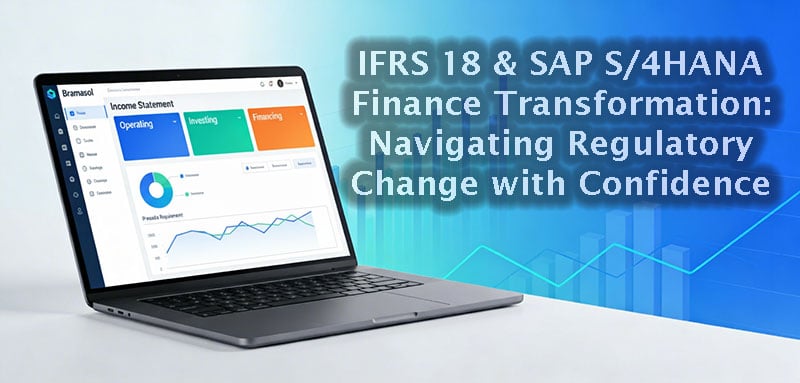
The International Accounting Standards Board (IASB) has adopted this new requirement, IFRS 18 “Presentation and Disclosure in Financial Statements”, which applies to annual periods beginning on or after January 1, 2027. IFRS 18 effectively replaces much of IAS1 by introducing a redesigned statement of profit or loss with mandatory categories, including operating, investing, financing, income tax, and discontinued operations.
According to the IASB, IFRS 18 represents the most significant change to companies’ presentation of financial performance since IFRS was introduced. Therefore, companies need to actively plan now to assure compliance.
What is Changing Under IFRS 18
IFRS 18 sets out overall requirements for presentation and disclosure in financial statements. It requires an entity to present a complete set of financial statements at least annually, with comparative amounts for the preceding year (including comparative amounts in the notes). While it replaces IAS 1 Presentation of Financial Statements, the IASB did not reconsider all aspects of IAS 1 when developing IFRS 18. Instead new changes in IFRS 18 focus on the statement of profit or loss.
Entities must now present standardized subtotals such as “operating profit” and “profit before financing and income tax,” significantly tightening comparability across companies and industries. IFRS 18 also changes the starting point and some classifications in the statement of cash flows, using operating profit as the starting point for the indirect method and prescribing where interest and dividends are presented.
IFRS 18 aims to improve financial reporting by:
- Requiring an entity to present two new defined subtotals in the statement of profit or loss—operating profit and profit before financing and income taxes.
- Requiring an entity to disclose management-defined performance measures, including subtotals of income and expenses not specified by IFRS Accounting Standards that are used in public communications to communicate management’s view of an aspect of a company’s financial performance.
- Adding new principles for aggregation and disaggregation of items.
US multinationals that have IFRS-reporting subsidiaries, issue IFRS consolidated financials for foreign listings, or prepare dual US GAAP/IFRS information will need to adopt IFRS 18 for those IFRS financial statements from periods beginning on or after January 1, 2027 (with restated comparatives).
New Disclosure and Management-defined Performance Measures (MPM) Requirements
IFRS 18 introduces enhanced aggregation and disaggregation principles, requiring clearer explanations in the notes of how items are grouped or broken out, so users can better understand what truly drives performance. Companies will need to analyze operating expenses by nature, by function, or via a mixed model and support any functional presentation (such as cost of sales) with more granular disclosures about the nature of those costs in the notes.
A major feature is the treatment of management-defined performance measures (MPMs): entities must identify MPMs used in public communications, explain them, disclose how they are calculated, and reconcile them to IFRS-defined subtotals in the financial statements.
This represents a step change in transparency around non‑GAAP metrics and will likely prompt significant dialogue with investors, boards, and audit committees as key performance indicators and historical trends appear differently under the new structure.
Operational and Systems Implications
The redesigned P&L and expanded disclosure rules will require updates to the chart of accounts, data models, and consolidation processes so that income and expenses can be consistently classified by operating, investing, and financing categories across entities.
Many organizations will need to introduce new data capture points and reconciliation processes, particularly for MPMs, expense-by-nature detail, and reconciliations between management reporting and IFRS 18 subtotals.
IT and finance transformation teams should anticipate changes to consolidation workflows, reporting hierarchies, and interfaces between operational systems and the general ledger, especially where segment reporting or management reporting currently diverges from IFRS views. Because IFRS 18 requires retrospective restatement of comparatives, companies need to plan for dual reporting during transition, maintaining both IAS 1 and IFRS 18 views for at least one comparative period, which amplifies the need for robust system automation and controls.
What Companies Need to Do Now
To prepare effectively, companies should: perform an impact assessment of current income statement and cash flow structures, identifying where classification will change; inventory all publicly communicated performance measures and determine which will qualify as MPMs under IFRS 18. To accomplish this, companies need a future‑state reporting architecture, chart of accounts, consolidation logic, and disclosure templates, that align management reporting, segment reporting, and IFRS 18 requirements to minimize manual adjustments and reconciliation risk.
In parallel, finance leaders need a stakeholder communication plan to explain new subtotals, shifts in key metrics, and comparative restatements to investors, analysts, boards, and internal management. Training for finance, controllership, and FP&A teams will be essential so they can explain variances between legacy and IFRS 18 views, interpret new categories, and integrate MPM governance into budgeting, forecasting, and performance dashboards.
Although it becomes effective for periods beginning on or after 1 January 2027, companies will need IFRS 18 compliant comparative information by 31 December 2026, which means dual views and restatements must be in place well before that date.
What This Means in an SAP S/4HANA Landscape
For SAP customers, IFRS 18 is not just a disclosure exercise; it directly affects the consolidation chart of accounts, financial statement hierarchies, MPM governance, and the way operating and consolidation ledgers are mapped. SAP S/4HANA Group Reporting is designed to handle evolving standards and already provides capabilities such as parallel versions, flexible financial statement (FS) mapping, and robust hierarchy management that are highly relevant for IFRS 18 transition.
Key current capabilities in SAP S/4HANA Group Reporting that matter for IFRS 18 include:
- Consolidation Extension Versions: These allow you to create derived consolidation versions from a base version so you can run “restated IFRS 18” in parallel to “current IAS 1” without disrupting official results, supporting dual reporting for 2026 and beyond.
- Consolidation Chart of Accounts updates: The solution supports extending and maintaining the consolidation CoA in line with the new IFRS 18‑compliant income statement structure and subtotals.
- Mapping from Operating Chart of Accounts: Integration with the group reporting preparation ledger and custom substitution rules helps automatically derive categorized FS items (for example, operating vs investing vs financing) from underlying postings, reducing manual reclassifications.
Additional capabilities help sustain IFRS 18 over time rather than treating it as a one‑time project:
- Time‑dependent FS item hierarchies, with Group Data Analysis supporting restatement of prior periods using updated hierarchies by key date, so you can refresh historical views when structures change.
- Group Reporting Data Collection for capturing extra detail needed for items like expense breakdowns or adjusted EBITDA components that underpin MPMs.
- The new Consolidation Monitor, which lets you open and close multiple fiscal periods for multiple groups in one process, making it easier to manage extended close cycles during transition.
- Cross‑version balance validation to compare “Actuals” with a “Restated IFRS 18” version and reconcile differences, improving confidence in restated numbers.
Other Upcoming SAP Changes That Will Help with IFRS 18 Compliance:
SAP is updating its Group Reporting reference content (Scope Item 1SG) so that standard group‑level primary statements—balance sheet, income statement by nature and by function, cash flow (indirect), changes in equity, and comprehensive income—are IFRS 18‑compliant. Planned changes include extending and restructuring the consolidated income statement for IFRS 18 and updating the indirect cash flow statement to use operating profit (as defined in the new P&L structure) as the starting point.
New cloud customers will receive these IFRS 18‑compliant structures out‑of‑the‑box and can use them as a foundation for implementation. However, SAP cannot automatically overwrite configurations for existing live customers because those tenants often contain critical customer‑specific hierarchies, FS designs, and reporting rules that must be preserved.
For existing S/4HANA and Group Reporting customers, the onus is therefore on finance and IT teams to:
- Assess how IFRS 18 affects their specific structures, KPIs, and processes across Accounting, Group Reporting, Planning, and Analytics.
- Design and implement tailored updates to CoA, FS items, hierarchies, mappings, and versions in their own configured cloud ERP environments.
How Bramasol Can Help You Get Started Now
Bramasol has spent 30 years helping SAP customers operationalize complex accounting standards such as ASC 606 and IFRS 15, build robust disclosure reporting, and implement SAP S/4HANA and Group Reporting in ways that stand up to real‑world audit and regulatory scrutiny. That experience is directly applicable to IFRS 18, where success depends on marrying a deep understanding of the standard with hands‑on knowledge of how to redesign charts of accounts, hierarchy structures, and data flows inside SAP.
Specific ways Bramasol can help SAP customers get ahead of IFRS 18 include:
- IFRS 18 impact and design workshops that translate the standard into concrete SAP S/4HANA and Group Reporting design decisions—CoA extensions, FS item categorization, version strategy, and MPM data requirements.
- Configuration and enhancement of Consolidation Extension Versions, mapping rules, and time‑dependent hierarchies to enable dual reporting (legacy vs IFRS 18) and smooth comparative restatements.
- Implementation of connected disclosure and analytics solutions using Bramasol’s revenue and disclosure reporting frameworks so MPMs (like adjusted EBITDA) are consistently defined, reconciled to IFRS subtotals, and surfaced in dashboards and narrative reports.
Because Bramasol’s expert teams understand both SAP’s standard IFRS content and the kinds of customizations enterprises layer on top, they are well positioned to help existing customers use SAP’s upcoming IFRS 18 reference content as a blueprint while preserving what is unique and valuable in their current designs.
The result is an IFRS 18 program that not only delivers compliance for 2026–2027 but also modernizes group reporting, strengthens control over non‑GAAP measures, and enhances the quality of insight that finance delivers to the business.