.gif?width=320&height=80&name=7-logo-30years%20(1).gif "7-logo-30years (1)")

Turning the Digital Core into Enterprise Transformation
In a previous Insights post, we explored the benefits of Leveraging a Finance First Approach for SAP S/4HANA Transformation Projects. With this and subsequent Insights posts, we look deeper at how the finance-first approach enables targeted improvements to other business functions throughout the enterprise.
Once finance is live on SAP S/4HANA, the real transformation work begins. A finance-first approach gives organizations a stable, standardized digital core, and that foundation opens the door to broader process innovation across supply chain, procurement, projects, manufacturing, and warehousing.
The next step is to avoid rushing into every remaining function at once. Instead, leading organizations use the finance foundation to prioritize the next business areas that will deliver the greatest value, while continuing to strengthen data quality, process governance, analytics, and integration across the SAP landscape.
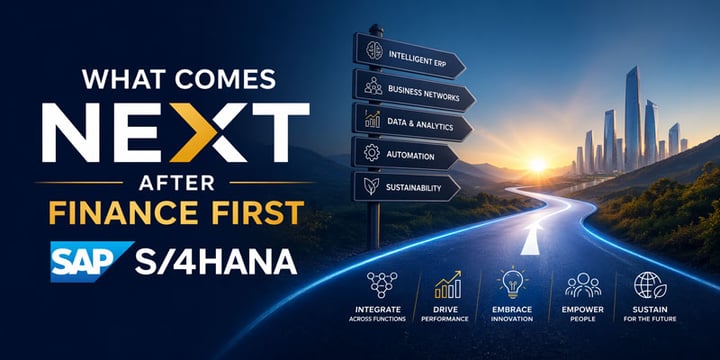
Build on the finance foundation
Finance-first succeeds best when it creates more than a technical cutover. It establishes trusted master data, harmonized reporting, and a cleaner operating model that other functions can adopt with less risk and less rework.
From there, companies should map the road ahead with intentional focused initiatives. Each phase should connect directly to a measurable business outcome, such as improved manufacturing efficiency, stronger procurement controls, or improved operational planning.
Keys to success
Several factors determine whether the finance-first model becomes a true transformation platform.
- Standardize processes early so the organization is not rebuilding legacy complexity in the new system.
- Treat data quality as a priority, not a cleanup task at the end of the project.
- Align finance, IT, and business leaders around clear goals and governance so the next phases stay coordinated.
- Use structured testing and iterative validation before expanding scope, so issues are found while they are still inexpensive to fix.
- Choose the next process phase based on business value, not convenience, so momentum stays tied to outcomes.
Let's take a closer look at specifics for two key areas: Manufacturing and Supply Chain.
Manufacturing Transformation
After finance go-live, many companies start with high-value manufacturing scenarios that help planners, supervisors, and operators work faster. Good first use cases are natural-language navigation to production and inventory apps, status checks for orders and materials, exception handling, and guided actions tied to common shop-floor decisions.
Design for the Big Picture and AI Integration
Begin with informational and navigational experiences before moving to transactional automation. In practice, that means users ask Joule questions like “show open production orders,” “what materials are at risk,” or “where do I release a blocked order,” and then you add more advanced actions once the process and security model are proven.
Establish Governance Practices
Manufacturing AI use cases need strict role design, data access controls, and testing because they touch live operational decisions. A phased rollout works best: validate master data, confirm authorizations, test integrations, and pilot with one plant or one process line before expanding across the enterprise.
Supply Chain Transformation
Extending S/4HANA into supply chain after a finance go-live requires an emphasis on data, integration, testing, and change management. The biggest challenge is that supply chain typically requires cleaner master data and tighter process alignment than finance alone, so the “finance-first” foundation has to be hardened to support planning, procurement, inventory, and execution.
Critical Issues
- Master data quality. Material, vendor, BOM, and plant data often have gaps or duplicates, and those issues quickly surface in planning, availability checks, and fulfillment.
- Integration complexity. Supply chain processes usually span S/4HANA, Extended Warehouse Management (EWM), Transportation Management (TM), Manufacturing Execution System (MES), and third-party logistics systems, so interface failures can interrupt operations fast.
- Process misalignment. Legacy workflows often do not match S/4HANA best practices, which creates rework if teams try to preserve old process steps unchanged.
- Testing burden. Supply chain requires robust end-to-end testing of data flows across order-to-cash, procure-to-pay, and plan-to-produce, in addition to of localized testing in isolated modules.
- Change adoption. Plants and supply chain teams need role-based training and new operating discipline, or the business will keep falling back to manual workarounds.
Keys to reducing risk
- Clean up master data before expanding scope, especially material, vendor, and location records.
- Prioritize critical interfaces and test them early with real scenarios, not just technical connectivity checks.
- Standardize supply chain processes where possible instead of recreating legacy exceptions in the new system.
- Run mock cutovers and full process rehearsals for planning, procurement, warehouse, and production flows.
- Use a pilot rollout in one plant, region, or business unit before scaling enterprise-wide.
How Bramasol leads from Core to Scale
The goal is not simply to “finish finance.” The goal is to turn finance into the platform for continuous modernization. With the digital core in place, companies can extend SAP S/4HANA into other functional areas, along with SAP Business AI and Joule-enabled use cases.
That is where the finance-first strategy truly proves its value. It reduces risk at the beginning, creates confidence in the new environment, and makes future transformation phases faster and more strategic.
Bramasol is perfectly positioned to guide client companies through their entire multi-phase transformation process because our holistic approach is built around finance-led cloud ERP transformation with a comprehensive roadmap to strategically improve additional line-of-business areas across the enterprise. We combine SAP best practices, phased data migration, and native integration patterns to help customers move from a stable financial core to broader enterprise adoption.
This matters because the transition after finance is often where some companies may lose focus. Bramasol keeps the program moving by helping clients define the next-phase roadmap, rationalize process design, and mesh finance with other key functions in a controlled, scalable manner.
Watch for future Insights posts that will focus on other key areas, including procurement, projects, warehousing, reporting, user training, data management, planning, AI evolution, and more.