.gif?width=320&height=80&name=7-logo-30years%20(1).gif "7-logo-30years (1)")

The semiconductor industry is shifting from one‑time chip sales to focus on emerging trends toward ongoing, outcome‑based services, powered by recurring revenue models, that are reshaping how companies design, deliver, and monetize silicon over its lifecycle.
From Chips as Products to “Silicon as a Service”
Traditionally, semiconductor revenue has centered on large, upfront orders for wafers, packaged chips, and IP licenses, with limited post‑sale engagement beyond support and refresh cycles. Today, recurring revenue models are emerging that turn silicon and surrounding software into continuous services, such as:
- Design IP subscriptions that bundle IP blocks, tools, and updates under annual or multi‑year contracts.
- Silicon lifecycle management (SLM) services that monitor deployed chips in the field for performance, reliability, and security.
- Software, firmware, and enablement stacks sold as subscriptions on top of hardware platforms.
In this new landscape, revenue is no longer tied only to tape‑out and shipment; it flows over years as customers consume capabilities, insights, and updates derived from the chips they deploy.
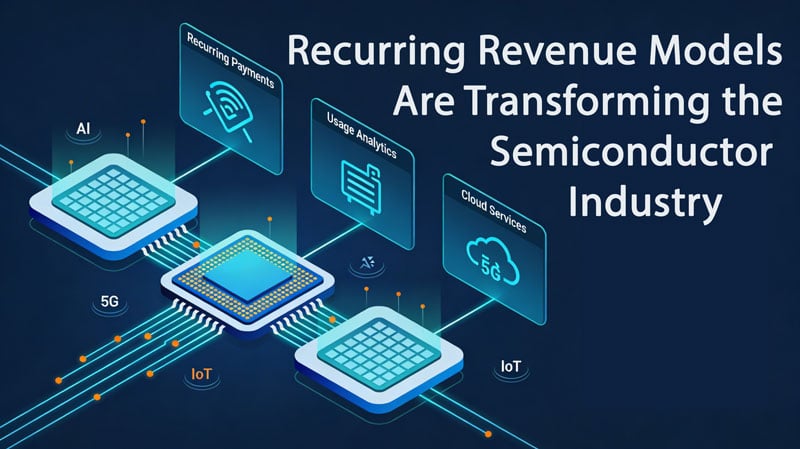
Why Recurring Revenue Is Rising in Semiconductors
Several structural forces are pushing chip makers and ecosystem players toward subscription and usage‑based models.
- Exploding complexity and NRE: Advanced nodes, 3D packaging, and domain‑specific architectures make one‑time license models less attractive; shared‑risk subscriptions spread non‑recurring engineering (NRE) costs over time.
- Software‑defined everything: From vehicles to networks to data centers, value increasingly comes from software running on standardized compute platforms, creating room for software and services subscriptions around the silicon.
- AI and data‑centric workloads: Always‑on AI inference, edge analytics, and accelerator farms benefit from capacity and enable usage‑based offerings where customers pay for performance delivered rather than chips alone.
- Supply‑chain and demand volatility: Recurring contracts help smooth revenue across cycles, giving chip makers more predictable cash flows and closer alignment with customers’ long‑term roadmaps.
As a result, leading players are actively pairing silicon with software, data, and managed services to secure stable, multi‑year relationships. A variety of innovative recurring models are taking shape across the semiconductor value chain.
- IP‑as‑a‑Service: Instead of perpetual IP licenses, customers subscribe to IP portfolios with continuous updates, new variants, and support, often tied to specific process nodes or end markets.
- Silicon platforms with software subscriptions: System-on-Chip (SoC) vendors ship hardware once but sell recurring access to software developer kits (SDKs), compilers, optimized libraries, and performance enhancements over the product life.
- Silicon lifecycle and reliability‑as‑a‑service: Embedded telemetry in chips streams data back to providers, who offer monitoring, predictive failure analytics, and reliability guarantees on a subscription basis.
- Security‑as‑a‑service for devices: Root‑of‑trust (RoT) hardware, secure elements, and crypto accelerators are paired with recurring cloud services for key management, firmware signing, and threat analytics.
- Capacity‑ and accelerator‑as‑a‑service: For AI and specialized compute requirements, some semiconductor companies and partners provide dedicated accelerator capacity under recurring contracts, blending hardware, hosting, and support.
These models open new revenue pools but also require more sophisticated contract structures, data integration, and financial controls.
Operational and Financial Challenges Behind the Scenes
Like other industries that are moving to recurring revenue models, semiconductor companies face real execution challenges:
- Complex pricing and packaging: Hybrid models that mix hardware delivery, IP access, support tiers, and usage‑based charges demand robust product catalogs and configuration rules.
- Data collection and entitlement management: Tying device‑level telemetry, software usage, and license entitlements back into billing systems is non‑trivial when products span on‑premise, edge, and cloud domains.
- Revenue recognition and compliance: Companies must separate hardware revenue from ongoing performance obligations (software, security updates, analytics), recognize revenue over time, and handle contract modifications and variable usage.
- Customer experience and transparency: Long‑term subscriptions require clear SLAs, predictable billing, and explainable metrics (for example, “how was this usage charge calculated?”) to avoid disputes and churn.
These pressures are pushing semiconductor firms toward integrated quote‑to‑cash and subscription management platforms that can handle recurring and usage‑based business at global scale.
How SAP and Bramasol Can Help Semiconductor Leaders
SAP and Bramasol bring capabilities proven across many other industry sectors to help semiconductor companies operationalize subscriptions and usage‑based revenue.
- SAP Subscription Billing and SAP Convergent Charging enable flexible, granular pricing for IP subscriptions, software features, and telemetry‑driven services, including hybrid models (such as base fee plus usage).
- SAP provides scalable rating and billing for high‑volume usage, while SAP S/4HANA supports compliant, event‑based revenue recognition that separates hardware, software, and service obligations.
- Bramasol’s accelerators and implementation expertise help semiconductor organizations quickly stand up integrated quote‑to‑cash stacks, unify technical usage data with billing, and embed controls for complex, multi‑year contracts.
By tightly connecting device and software usage data with pricing, billing, and accounting in a single cloud‑based stack, semiconductor companies can turn traditional, cyclical chip sales into durable, recurring revenue streams—while giving customers the ongoing value, flexibility, and transparency they now expect.